On a snow covered frontline in Ukraine, a new Russian winter camouflage suit was supposed to hide infantry from watchful eyes. Instead, it has turned them into textbook targets.
Recent battlefield footage shows at least two troops from Russia in an experimental outfit nicknamed “Penguin” being located and killed by Ukrainian first person view drones, according to Ukrainian military reports and multiple open source analyses.
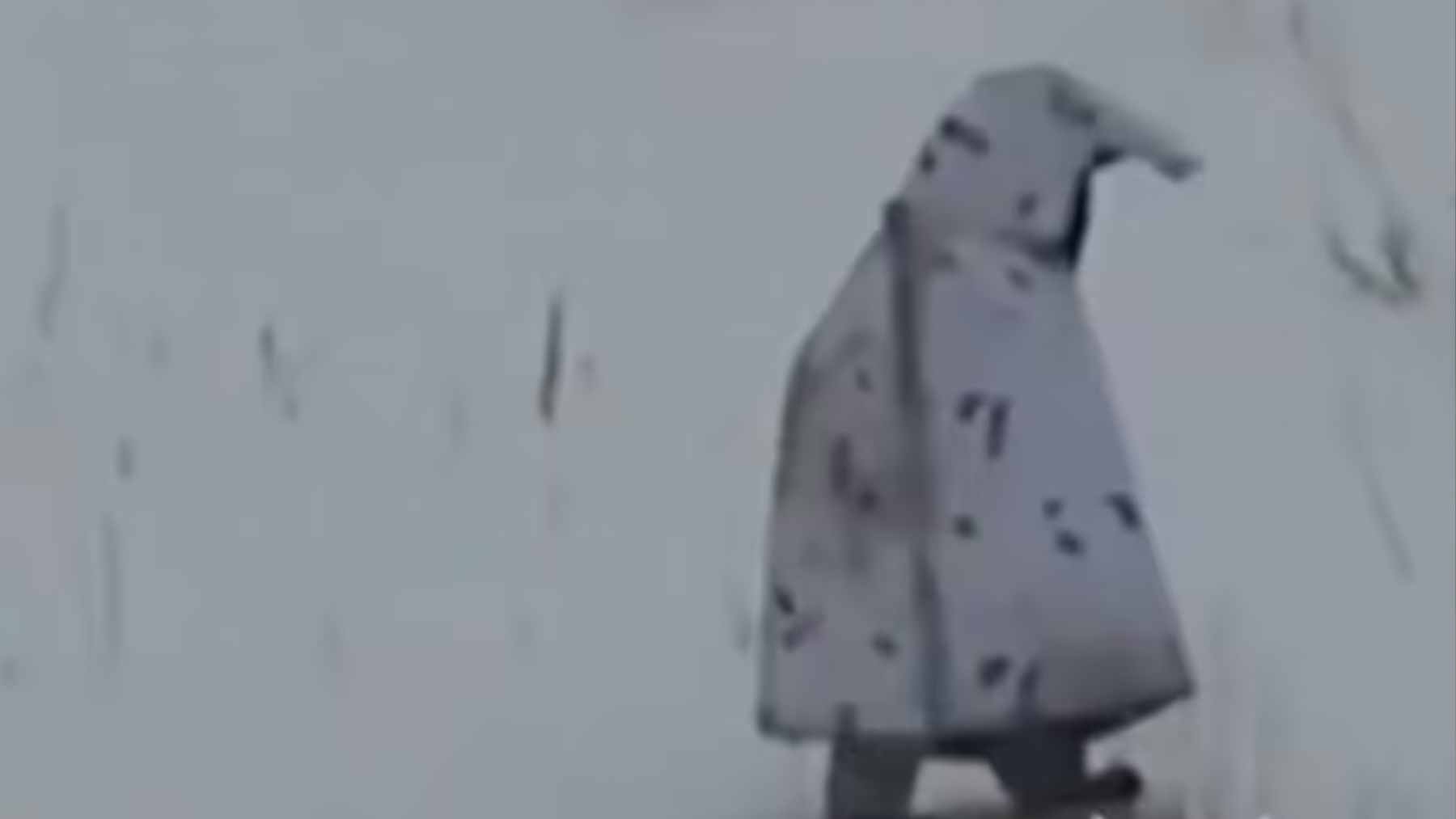
The suit looks almost comic at first glance. It is a bulky white shell with scattered dark spots and a tall pointed hood that gives the wearer a waddling bird silhouette against the snow.
A fact checking investigation by Maldita notes that the clip was first posted by the 120th Territorial Defense Brigade on Facebook, with soldiers joking in a chat that “here we have penguins walking.” The brigade told Maldita the engagement took place near the city of Limán in the Donetsk region, although that location has not been independently verified.
Camouflage built for eyes instead of sensors
Underneath the memes there is serious engineering intent. Experts interviewed by Maldita say the outfit matches a thermal camouflage poncho designed to trap a soldier’s body heat inside and reflect the cold air outside, so that for a drone’s infrared camera the person looks roughly as “cold” as the snow around them.
The loose shell also tries to erase the familiar outline of head, shoulders and limbs, a principle long used in sniper ghillie suits and classic winter smocks.
That idea made sense when the main threat was a human observer with binoculars. On today’s Ukrainian battlefields, though, cheap FPV drones, thermal viewers and motion tracking software scan the ground almost nonstop. If you have ever watched a home security camera send a motion alert to your phone, you already understand the basic problem.
So what happens when the eye searching for you belongs to a drone operator staring at a high resolution thermal feed instead of a guard in a trench.
When hiding makes you stand out
Reports gathered by outlets such as Defence Blog and Interesting Engineering suggest the Penguin suit is so voluminous that it slows its wearer and forces a kind of shuffle to keep balance on the snow.
Anything that moves with that stiff, unnatural rhythm pops out immediately on a drone screen, especially across a flat white field where almost nothing else is moving.
In one widely shared clip, a soldier in the suit walks alone across open ground before an FPV drone angles in and detonates nearby, the cape offering no protection once he has been spotted.
Imagine trying to cross an icy parking lot wrapped in an oversized sleeping bag. You would take tiny careful steps, probably wobble a little, and anyone glancing out a window would notice you right away.
Ukrainian troops say that, to a large extent, the Penguin suit has the same effect. Instead of blending in, it creates a strange, rounded shape moving at a slow, steady pace that is very easy for a drone pilot to track and aim at.
The Penguin outfit also fits a broader pattern. Ukrainian media have previously documented other Russian experiments with individual “capsule” shelters and improvised anti drone gear that likewise failed to stop FPV strikes.
Analysts note that Russian units often push new equipment straight into combat with minimal testing, which effectively turns front line soldiers into real time test subjects for unproven designs.
For militaries watching this from afar, the lesson is uncomfortable. Camouflage that only tricks the human eye looks increasingly outdated on a battlefield filled with cheap drones, infrared optics and software that reads patterns in how things move and radiate heat. Future uniforms and field gear will have to account for all of that or risk repeating the Penguin experiment under a different name.
The report was published on United24 Media.