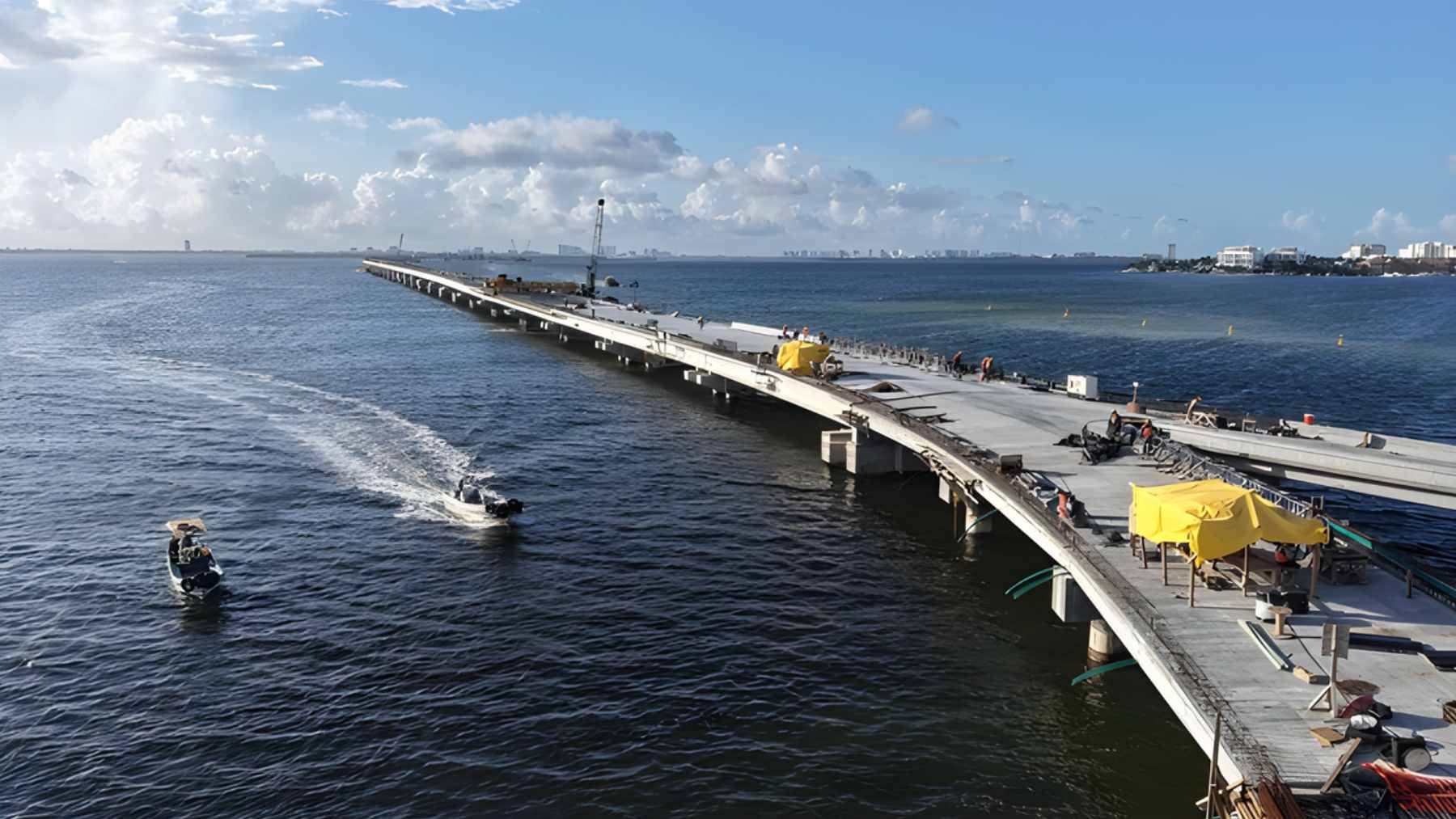
If you’ve ever crawled toward Cancun’s Hotel Zone in bumper-to-bumper traffic, you know how a “quick trip” can turn into a sweaty, stop-and-go hour. Mexico’s Puente Vehicular Nichupté is designed to change that by adding a new route over the Nichupté lagoon system, with the official project record pointing to an April 2026 start of operations.
But the bridge is not being sold as pavement alone. Officials and project documents frame it as a sustainability test case, pairing mobility upgrades with large-scale mangrove restoration and other ecological mitigation.
The question is not whether the bridge will open, it is whether the environmental wins will still be visible years from now.
A new route for a fragile place
The Nichupté project is an 11.2-kilometer corridor that includes an 8.8-kilometer bridge with three lanes, including one reversible lane, plus connectors and a 103-meter metal arch section. Plans also include a bike lane, which matters in a resort city where short trips often default to cars and taxis.
Officials say the payoff is time and reliability. The stated estimate is up to 45% saved per trip, with an average daily traffic projection around 20,000 vehicles, and the project is framed as serving both local residents and the tourism economy.
There is also a security and disaster angle that tends to get overlooked until the worst day arrives. The bridge is explicitly positioned as an alternate route for emergencies and natural disasters, and recent reporting says the structure is complete with finishing work and load testing ahead of opening.
Restoration on the construction schedule
Here is the headline environmental claim: the project is described as including roughly 306 hectares of mangrove restoration, making it the largest environmental restoration program tied to the infrastructure ministry for this build, along with 118 hectares of seagrass rehabilitation.
The permitting language matters just as much as the acreage. The project is reported as having 10 environmental programs and 25 subprograms authorized by SEMARNAT through a regional environmental impact process, covering prevention, mitigation, compensation, monitoring, and rehabilitation.
Why focus so hard on mangroves and seagrass? Because these coastal ecosystems can do double duty, helping protect shorelines and storing carbon in plants and soils. NOAA summarizes this “coastal blue carbon” role and notes that mangroves and seagrass beds provide storm protection benefits along with climate benefits.
The business bet and the bill
In straight business terms, the bridge is pitched as a growth and productivity tool for a tourism hub. The project has been credited with roughly 51,000 direct and indirect jobs during construction, and official framing often centers on improving the connection between the city and the Hotel Zone for the millions of visitors who cycle through each year.
Still, big infrastructure comes with a number that eventually lands on the public ledger.
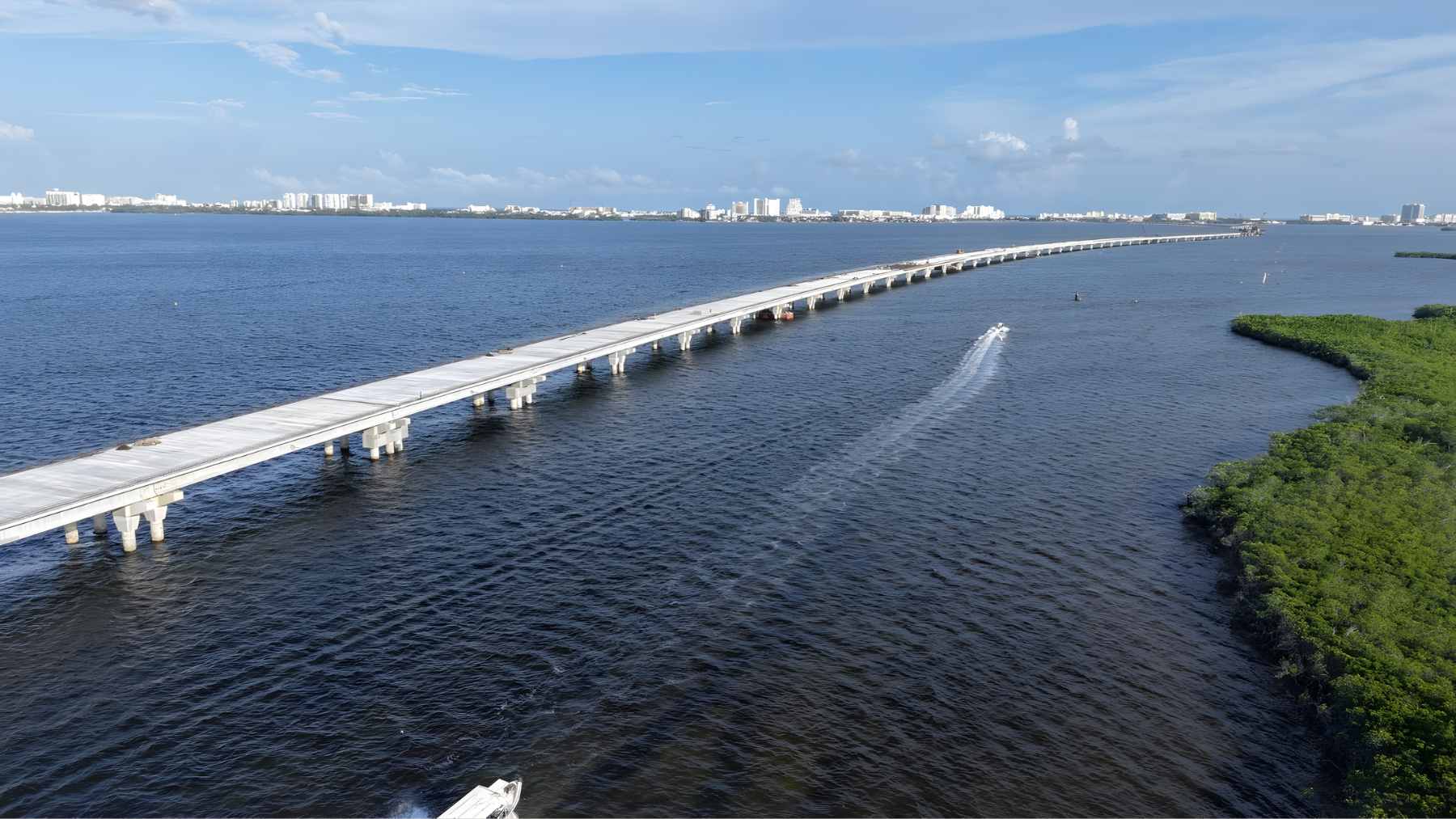
El Economista reports the cost has climbed to about 11.809 billion pesos ($660 million), which it describes as a 112% overrun versus the 5.57 billion-peso figure tied to the original 2022 award, and it also reports federal auditors found 494.8 million pesos ($27.7 million) in irregularities tied to the 2024 public account review sample.
SICT responded that the finding is an observation in process, not a finalized determination of loss, and that it would provide documentation under the formal review timeline.
Smart infrastructure and security
One detail in the official project record hints at where transportation tech and public safety meet. Proyectos México says the bridge is expected to include intelligent transport systems connected to a “C4” security center, alongside lighting and planned stops, which signals a corridor designed for monitoring and active management, not just asphalt.
In much of Mexico, “C4” refers to a command, control, communications, and computing center that helps coordinate emergency reports and response, often tied to monitoring and dispatch workflows. That kind of setup can make a real difference when a crash blocks a lane, or when evacuations and emergency access suddenly become the priority instead of commute times.
The same tech mindset can help on the environmental side, too. Remote sensing approaches using long time-series satellite imagery are increasingly used to monitor mangrove change and restoration outcomes over time, which is exactly what you would want to validate a project that promises restoration at scale.
If Cancun’s monitoring results end up published in a clear, regular format, it could become a model other coastal megaprojects copy.
What to watch after opening
Once the ribbon is cut, success should be measurable in everyday ways. Are commute times actually falling during peak tourist season, and does the reversible lane help or confuse traffic when people are tired, late, and staring at a GPS screen?
Just as important, the environmental metrics need to stay public. Mangrove survival, seagrass coverage, water quality, and wildlife activity will tell the real story, and those numbers matter most after the construction crews are gone and the political spotlight moves on.
The official project record was published on “Proyectos México,” and the long-term environmental plan will be judged in the same way commuters judge a morning drive, by what actually improves once the route is open.
The official statement was published on SICT.