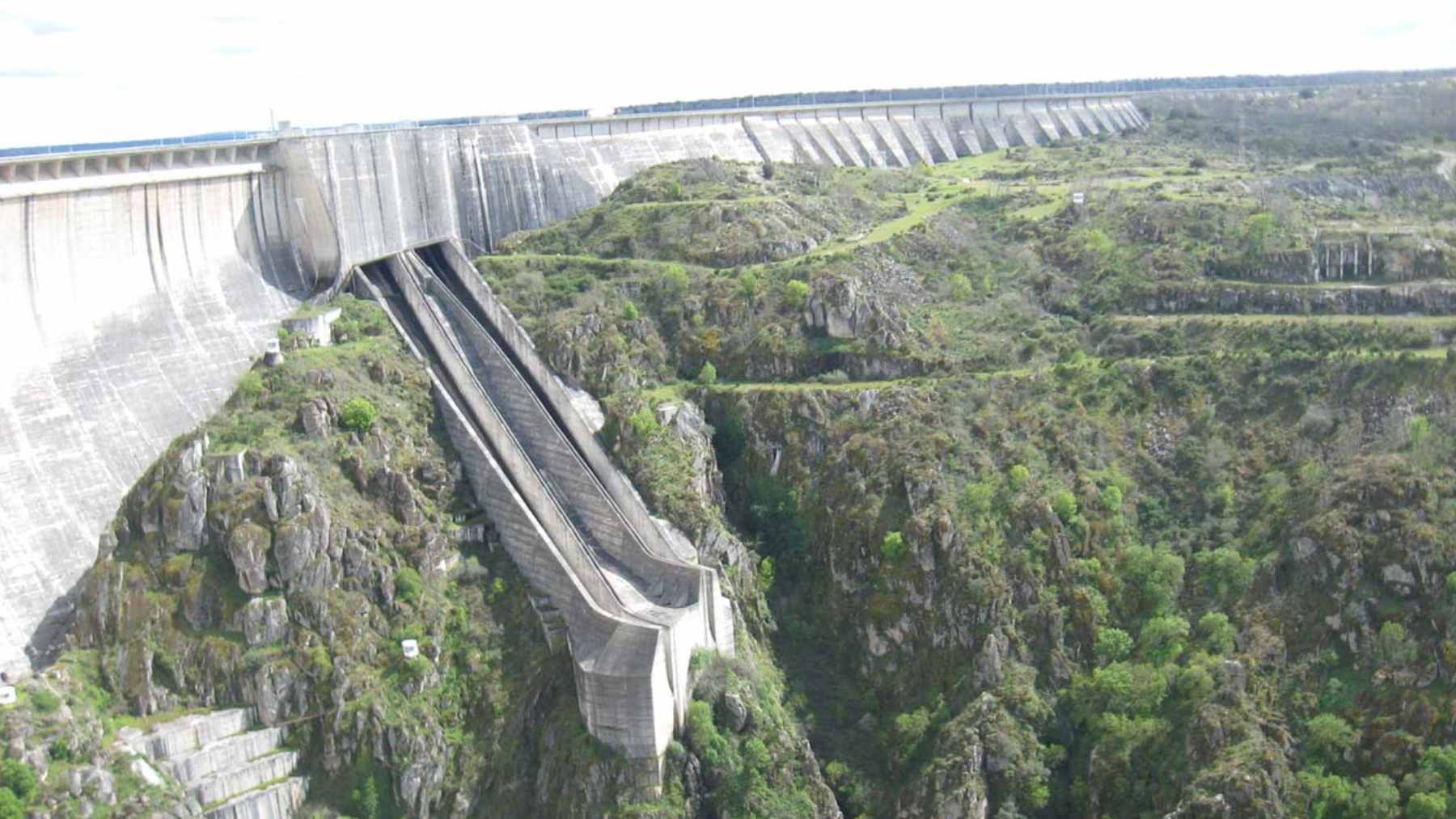
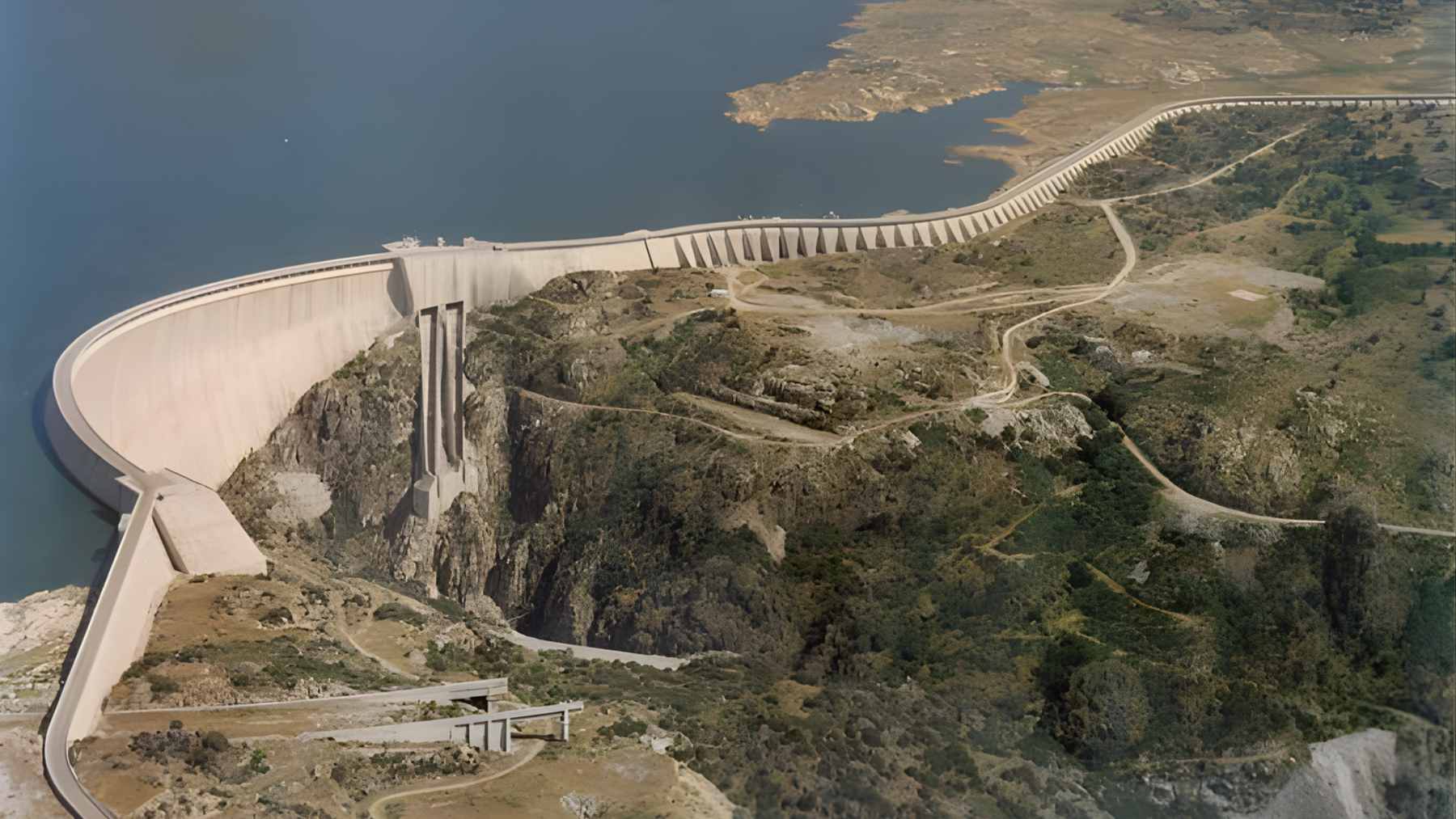
The dam sits where the Tormes carves a deep canyon on the border between Salamanca and Zamora. From the valley floor the structure rises about 202 meters, making it the highest dam in the country.
The crest stretches roughly 567 meters, curving in a vault shape that lets the wall lean into the water and transfer pressure to the rock on each side.
Behind that wall spreads a reservoir that covers about 8,650 hectares and can hold well over 2,600 cubic hectometers of water. Each cubic hectometer equals one million cubic meters, so we are talking about billions of cubic meters stored in a single basin.
That makes Almendra Spain’s third largest reservoir by capacity, behind La Serena and Alcántara in Extremadura.
The project took shape in the nineteen sixties, when work crews excavated around one and a half million cubic meters of rock and poured more than two million cubic meters of concrete to build the huge vault. It was finally completed around 1970, in the middle of a push for big hydroelectric schemes across the Duero basin.
Water reserves bounce back
Almendra’s size matters even more this winter because Spain’s reservoirs have filled at a pace not seen in decades. On February ten, the Environment Ministry reported national reserves at 77.3 percent of capacity, with 43,341 cubic hectometers of water stored.
Just ten days later, an analysis based on the same official data put the figure at 82.5 percent and 46,229 cubic hectometers, the highest level for that week since at least 1988. For everyday life that means fewer headlines about water trucks, more breathing room for farmers, and less fear that another scorching summer will arrive on nearly empty reservoirs.
Yet the picture is not perfect. The same data show that southeastern basins like the Segura still lag far behind, with structural deficits tied to arid climate and heavy irrigation. So while photos of overflowing dams dominate social media, experts warn that a few wet months do not erase years of drought risk.
How Almendra works like a giant battery
Hydraulic engineering is where Almendra quietly becomes an energy story. The wall you see from the road is only part of the system. Near the bottom of the reservoir an intake feeds water into a tunnel about 15 kilometers long and 7.5 meters wide, drilled through the granite toward the underground power plant at Villarino de los Aires on the Duero side.
Inside that cavern, reversible turbine generator units spin to produce electricity, taking advantage of a drop that in practice is much larger than the dam’s own height. Installed capacity at Villarino reaches about 856 megawatts, enough to supply hundreds of thousands of homes according to utility Iberdrola España.
Because those turbines can also run in reverse, the complex can act like a pump. When demand is low, for instance overnight or on very windy days, surplus electricity drives water back uphill from the Aldeadávila reservoir on the Duero into Almendra.
When the grid needs extra power, operators let that stored water fall again. In practical terms, this turns the dam into a giant water battery that helps balance variable renewable sources.
The village beneath the lake
There is a more somber side to the story. Before the reservoir filled, the Zamoran village of Argusino was evacuated and demolished. Around four hundred residents had to leave their homes in 1967, and the municipality was later divided between neighboring towns.
Most of the time, the ruins remain hidden under the water’s surface. In very dry years, stone walls and the outline of the old church emerge, drawing former residents and visitors who come to remember what was lost.
Their presence is a reminder that large dams often carry social and cultural costs alongside the electricity they provide.
An old megaproject in a new climate
At the end of the day, Almendra is a symbol of both the promise and the trade offs of big water infrastructure. It is part of a wider network of more than two thousand dams that help regulate floods, supply cities, irrigate fields, and keep power plants running.
In a climate that swings more often between severe drought and episodes of “too much water all at once,” reservoirs of this scale can cushion the extremes.
But engineers and policymakers also face hard questions. How much should the country rely on huge twentieth century walls, and how much should it invest in smaller, more flexible solutions.
How do you protect ecosystems in places like the Arribes del Duero while still using the river to keep the lights on. And how do you make sure communities affected by past projects are not forgotten when the next round of investments is planned.
For now, as winter rains push Spanish reservoirs to levels not seen in nearly forty years, the vast blue sheet behind Almendra’s concrete cliff shows just how powerful that combination of rock, water, and steel can be.
The official statement was published on Ministerio para la Transición Ecológica y el Reto Demográfico.