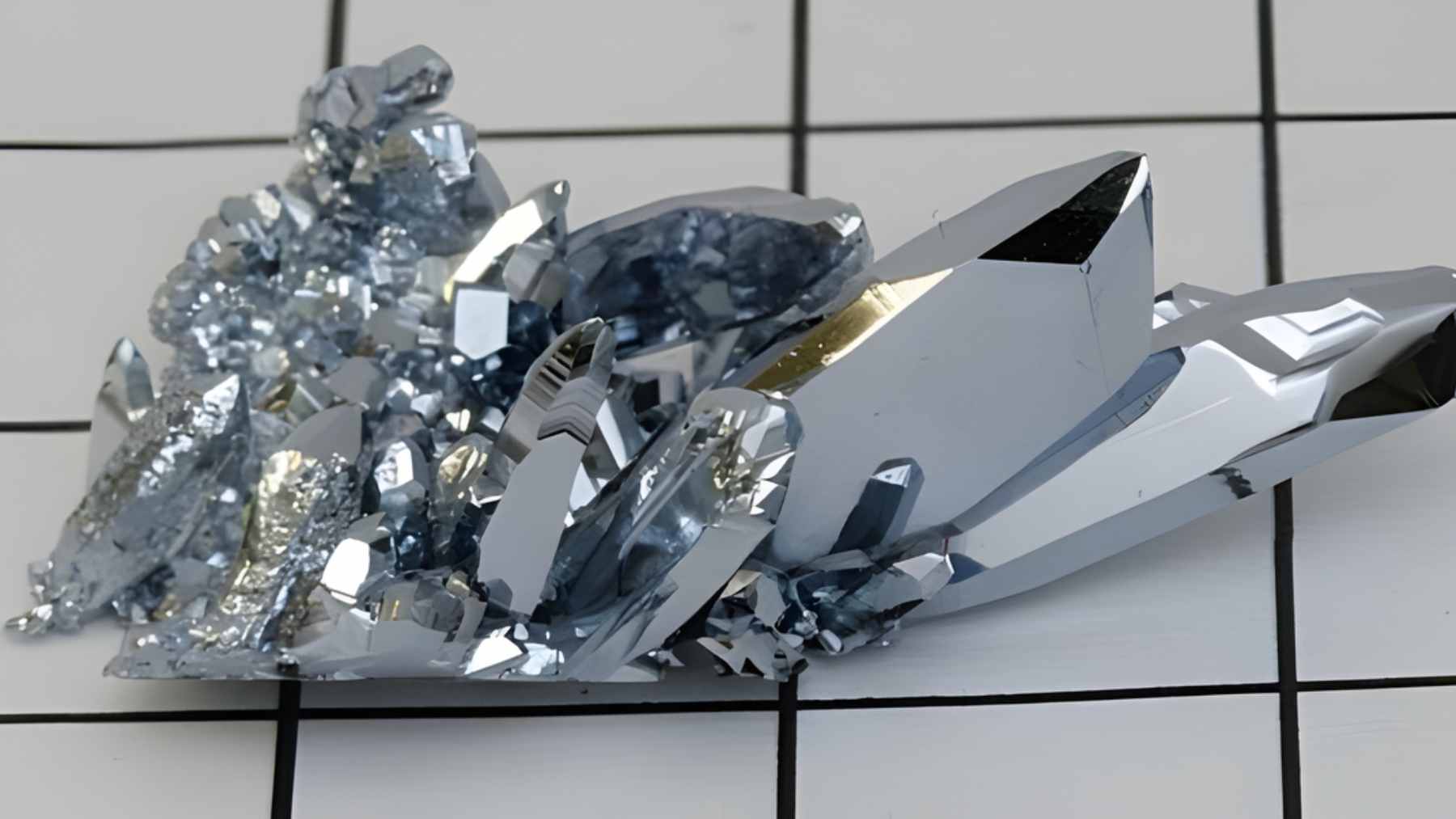
Forget gold, diamonds, or any flashy luxury brand. The most expensive material that industry actually buys today is a silvery metal almost no one outside nuclear labs has heard of. It is called californium 252, and recent estimates put its production cost around 27 million dollars per gram, roughly 23 million euros.
So why would anyone pay that much for a speck of metal smaller than a fingernail?
A man-made element that does not exist in nature
Californium 252 belongs to the actinide family, the same group that includes uranium and plutonium. Unlike those elements, this isotope does not occur naturally in Earth’s crust.
Scientists create it in specialized nuclear reactors by bombarding targets made of curium with neutrons for years, then carefully separating out the tiny fraction that turns into californium 252.
Only two facilities worldwide are known to have the right combination of reactor power and chemistry to do this, including Oak Ridge National Laboratory in the United States, which is currently the sole supplier in the Western Hemisphere.
In theory, californium is a soft, silver white metal. In reality, almost no one sees it bare, because it is sealed inside thick, shielded capsules as soon as it is made.
The isotope also has a short half life of about 2.6 years. That means any stored sample steadily loses strength, so producers must keep making new material just to replace what has decayed.
Why this tiny source is so expensive
The extraordinary price is not about branding. It comes from the harsh math of nuclear production. Reactors must run for many months to irradiate the targets, chemical processing is complex, and at the end of that long chain only milligrams of usable californium 252 remain.
Handling the isotope safely adds another layer of cost. It emits intense neutron radiation, so it has to be encapsulated, stored, and shipped in custom heavy shielding, with strict procedures that keep workers and the public away from unnecessary exposure.
What do buyers get for all that money? They get one of the most powerful compact neutron sources ever created. Studies report that a single microgram of californium 252 can emit well over one hundred million neutrons per minute, a level that rivals much larger reactor-based sources for some applications.
From lighting reactors to treating cancer
Those neutrons turn into very practical tools. In the nuclear sector, sealed californium sources act like a match that helps ignite a controlled chain reaction when a new reactor starts up, something documented for decades in technical reports and operational data.
Industry relies on the isotope for prompt gamma neutron activation analysis, a technique that lets engineers measure the composition of coal, cement, and mineral streams in real time, and for logging oil and gas wells deep underground, uses described in detail in classic work on californium 252 neutron sources.
In medicine, californium-based sources are used in certain forms of brachytherapy, where a tiny capsule is placed close to a tumor so that radiation is delivered locally instead of bathing the whole body.
Space-related work also benefits. Neutron sources based on californium appear in some research tied to planetary surface analysis and in testing systems that must detect hidden explosives or structural flaws, including projects involving NASA and other space agencies.
A hidden player behind everyday technology
Most people will never hear californium 252 mentioned on the evening news, yet its effects show up in places as familiar as the electric bill or a hospital oncology ward.
Power reactors that feed modern grids, cargo scanners that protect ports and borders, and some precise cancer treatments all depend, to a large extent, on intense neutron sources that this isotope helps provide.
At the end of the day, californium 252 is a reminder that the world’s most valuable materials are not always gemstones in a shop window.
Sometimes they are invisible capsules locked inside steel and concrete, quietly doing work that keeps lights on, infrastructure monitored, and patients treated, while other scientific expeditions and even genetic surprises remind us how many forms of hidden complexity are still being uncovered.
The official fact sheet was published by Oak Ridge National Laboratory.