In tomorrow’s wars, the winning side may be the one that never loses its signal. That is the bet behind a new optical receiver developed by researchers at the U.S. Space Development Agency, which is part of the U.S. Space Force.
Instead of talking with satellites using traditional radio, the prototype listens for tightly-focused laser beams. The team has now published the first performance results in the peer-reviewed journal Optical Engineering, describing a receiver that can keep working even when the incoming laser signal fades and surges as satellites race overhead.
At stake is more than a cleaner signal. The Pentagon wants a resilient, high-speed “space backbone” that can shuttle sensor feeds, targeting data, and command messages between hundreds of satellites and military users on the ground, at sea, and in the air.
From radio noise to pinpoint beams
For decades, military links have depended on radio waves. They spread in all directions, they bounce, and they can be jammed or drowned in the crowded electromagnetic spectrum. As both commercial and military satellites multiply in orbit, that spectrum crunch is getting worse.
Laser links work differently. Think of the contrast between a bare light bulb in a room and a laser pointer on a wall. Radios are the bulb. Laser communications are the pointer.
The beam stays narrow, carries far more data, and is much harder for an adversary to intercept or interfere with. Optical links also sidestep spectrum licensing fights, since they do not use the same radio bands telecom networks rely on.
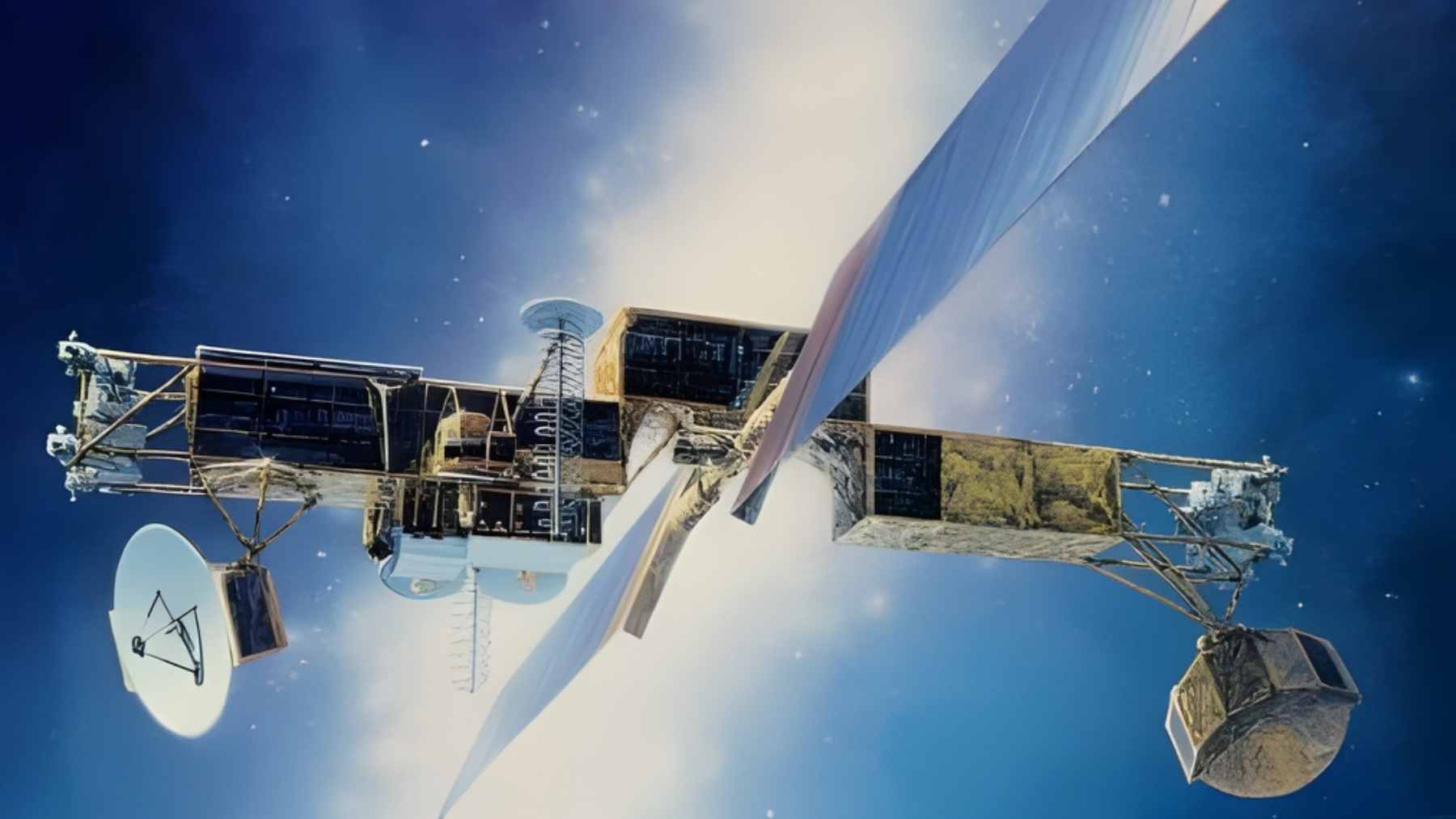
All of this feeds into the Proliferated Warfighter Space Architecture, or Proliferated Warfighter Space Architecture, a planned web of hundreds of small satellites in low Earth orbit that pass information between one another and down to tactical users. Interoperable laser terminals are meant to be the nervous system of that web.
What burst mode really means
The hard part is keeping a laser link alive when the signal strength swings wildly. As a satellite flies over a ground station, the received power can change by around 20 decibels because of distance, pointing geometry, and atmospheric turbulence.
Engineers turned to a technique called burst mode. Instead of shining continuously, the satellite transmits in very short, intense flashes with long gaps in between. Imagine flicking a flashlight on briefly at full brightness, then turning it off for the rest of the time to save your batteries.
In the SDA standard, two burst patterns are being adopted. One leaves the laser on for roughly one twelfth of the time, and another for about one sixteenth. By concentrating the same average power into those tiny windows, the signal seen during the burst becomes more than ten decibels stronger than an equivalent continuous transmission.
That helps the receiver pull data out of the noise when clouds, haze, or low elevation angles would normally kill the link.
There is a clear tradeoff. When the system falls back to the slowest burst format, the user data rate drops from more than a gigabit per second to only a few tens of megabits per second. In practical terms, that means high-definition video might have to pause, but critical text and targeting messages can still get through.
A different kind of receiver
Most high-end optical links rely on complex coherent receivers and adaptive optics that actively reshape distorted beams. Those designs can be fragile and expensive. The new SDA receiver instead uses a large area avalanche photodiode, a sensor that simply collects whatever light arrives and multiplies the resulting electrical signal.
Because the detector can tolerate a distorted beam, the system does not need bulky adaptive optics to clean up the wavefront first. According to the study, this approach keeps the design closer to what a deployable ground terminal might look like, whether it sits on a truck, a ship’s deck, or an aircraft.
The researchers report that the prototype receiver meets or comes close to theoretical expectations across a wide range of operating conditions when paired with the new burst mode waveforms.
They also describe it as the first avalanche photodiode-based receiver shown to be compatible with those SDA waveforms, while keeping sensitivity that matches or beats commercial options.
Building a space backbone, one standard at a time
Behind the lab work sits a larger policy shift. Rather than buying bespoke systems for narrow missions, the SDA is writing an Optical Communication Terminal standard that any vendor must follow if they want to plug into the future military space network.
That document spells out everything from how terminals initially find and track each other to how bits are formatted, coded, and acknowledged.
For the most part, the new receiver study stops short of declaring victory. The authors focus on characterization and validation, not on declaring the system ready for fielding. They note that atmospheric turbulence, pointing accuracy, and integration with existing command architectures still pose challenges.
Yet that is often how military technology matures. Step by step. First a standard, then a lab demo, later a rugged box bolted to a real vehicle. As global powers look upward and treat orbit as a contested theater, quietly reliable links may matter as much as rockets or radar.
The study was published in Optical Engineering.