How do you fit an elephant inside a single human cell without bursting it? In a lab in Slovenia, researchers have done something very close to that, using a ultra-precise laser to 3D print solid microstructures directly inside living human cells for the first time.
The work, published in the journal Advanced Materials, opens a new frontier that scientists are already calling “intracellular biofabrication”.
Human cells are tiny, about twenty micrometers across, roughly one fifth the width of a human hair. Inside that cramped space lives a dense crowd of proteins, organelles, and molecular machinery. Until now, getting anything larger than a small molecule into this environment without sealing it in a bubblelike compartment or killing the cell was almost impossible.
How do you print inside a cell?
The team at the Jožef Stefan Institute and University of Ljubljana used a technique called two photon polymerization, a form of laser 3D printing that hardens a special resin only at the laser’s focal point. First, they used ultra-fine glass needles to inject tiny droplets of a commercial photoresist, known as IP S, into HeLa cells, a widely-used human cell line.
Each droplet measured around ten to fifteen micrometers across, roughly half the width of the entire cell. When the scientists focused an ultrafast laser through a high-precision microscope, only the resin exactly at the focal point solidified.
By scanning that point through the droplet layer by layer, they “wrote” three dimensional shapes inside the cell while leaving the surrounding cytoplasm largely untouched. Any leftover, unpolymerized resin dissolved naturally in the cell interior.
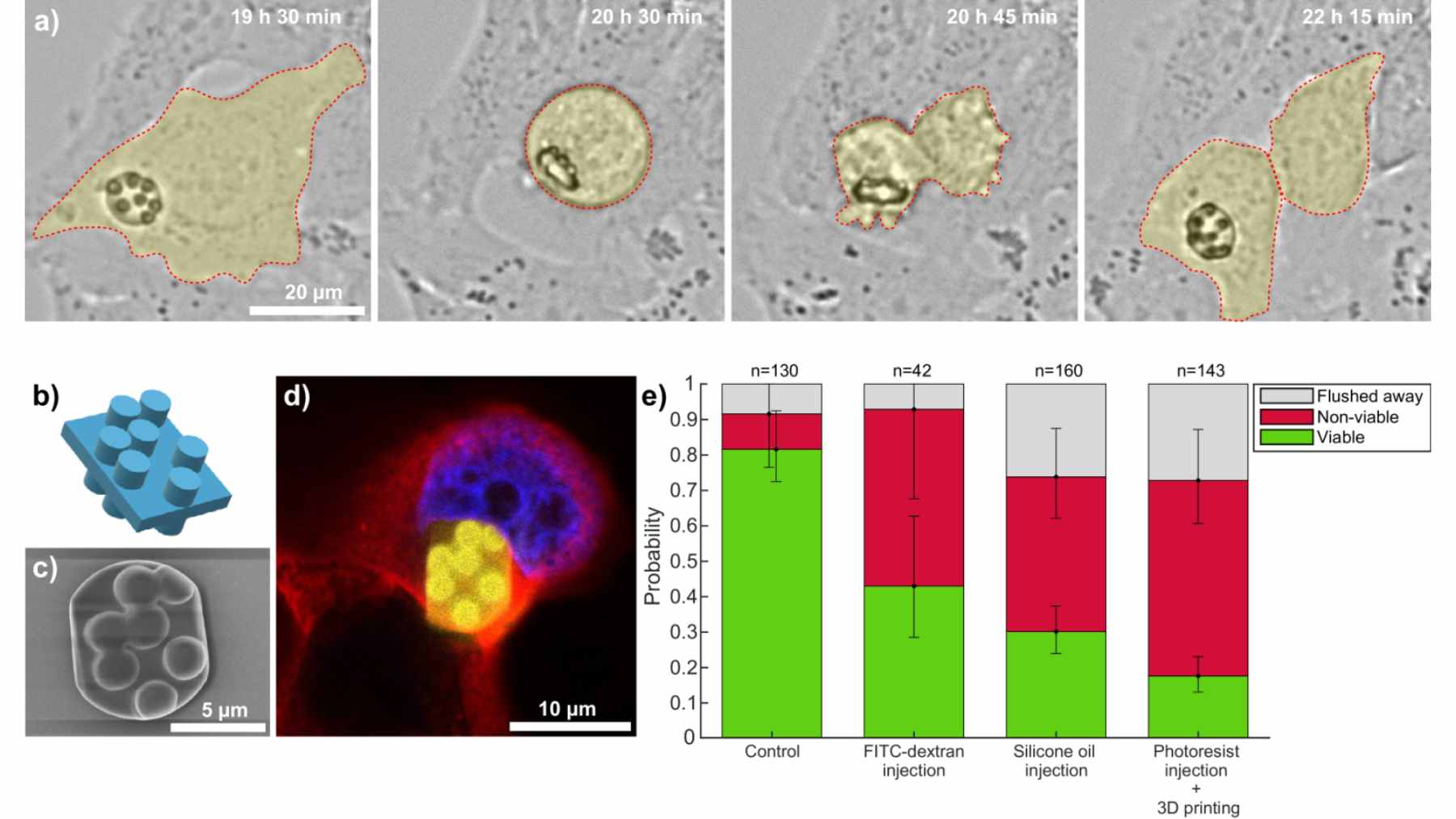
The shapes were not just simple blocks. The team printed a ten-micrometer elephant, laboratory logos, hollow spheres, lattice structures, barcodes for tracking cells, diffraction gratings, and even tiny microlasers. It is a bit like sculpting a miniature city inside a soap bubble and keeping the bubble intact.
Cells adapt to their new “roommates”
What happens to a cell that suddenly has a hard object sitting in the middle of its cytoplasm? Imaging showed that the printed structures really sat inside the cell, not stuck on the surface, and that nuclei sometimes stretched or bent around them to make space.
The procedure is invasive, and some cells do die. About forty five percent of cells with printed structures were still alive after twenty four hours, a survival rate comparable to simply puncturing the membrane with a needle, which kills around half the cells.
Those that survived generally kept their shape and continued to divide, passing the printed objects on to daughter cells like tiny heirlooms. Larger structures, especially those above five micrometers, delayed cell division by at least an hour, hinting that solid objects can nudge cell behavior in subtle ways.
Why this could matter for future medicine
For now, each cell must be injected one by one, which makes the method slow and strictly experimental. Still, being able to park stable, custom-shaped devices inside living cells points to intriguing possibilities.
The authors highlight potential uses in intracellular sensing, biomechanical manipulation, bioelectronics, and highly-targeted drug delivery, where a “device” inside the cell could release medication only when local conditions change.
It will take years, and probably new materials and delivery tricks, before anything like this touches clinical practice. Yet the basic idea is clear. Instead of only editing genes from the outside, researchers may one day engineer the physical interior of cells themselves, turning them into tiny labs that can report, react, and maybe even repair.
The study was published in Advanced Materials.