Faced with near nightly drone and missile strikes, Ukrainian officials are betting that artificial intelligence can make the skies less deadly and the electric grid more stable.
In partnership with U.S. defense software company Palantir Technologies and the government-backed defense tech cluster Brave1, Kyiv is setting up an AI-powered Brave1 Dataroom, a secure environment that uses real battlefield data so algorithms can learn to spot and intercept incoming threats in real time.
Officials say this system should give the country the foundation of a nationwide AI-assisted air defense layer within roughly six months.
Those ambitions are emerging after yet another brutal winter of attacks on cities far from the front line. Ukrainian accounts describe hundreds of Russian drones and missiles fired in single waves at power plants and heating infrastructure, pushing residents into public warming centers when the temperature outside drops well below freezing.
Reports in Ukrainian and international media note that Russia has at times used several hundred Shahed-type drones in one assault, turning the night sky into a swarm that traditional air defenses struggle to track and prioritize.
At the center of the new approach is the idea that software can help close that gap. The Brave1 Dataroom is built on Palantir’s platforms and already holds curated visual and thermal datasets of aerial targets, including Shahed drones.
Ukrainian defense tech companies that pass security checks will be allowed to plug into this environment and train AI models that recognize, classify, and track hostile objects, then hand off targeting information to interceptor drones.
In everyday language, the goal is to give Ukrainian operators something like a smart filter for the sky. Instead of staring at multiple screens of grainy feeds and radar tracks during a two-hour bombardment, crews could lean on software that flags the most dangerous objects and guides interceptors onto them as quickly and cheaply as possible.
That same logic is starting to shape security debates elsewhere, from U.S. planners looking at FPV drones over crowded stadiums to European navies testing laser systems like DragonFire against cheap flying threats.
Octopus interceptor on the front line
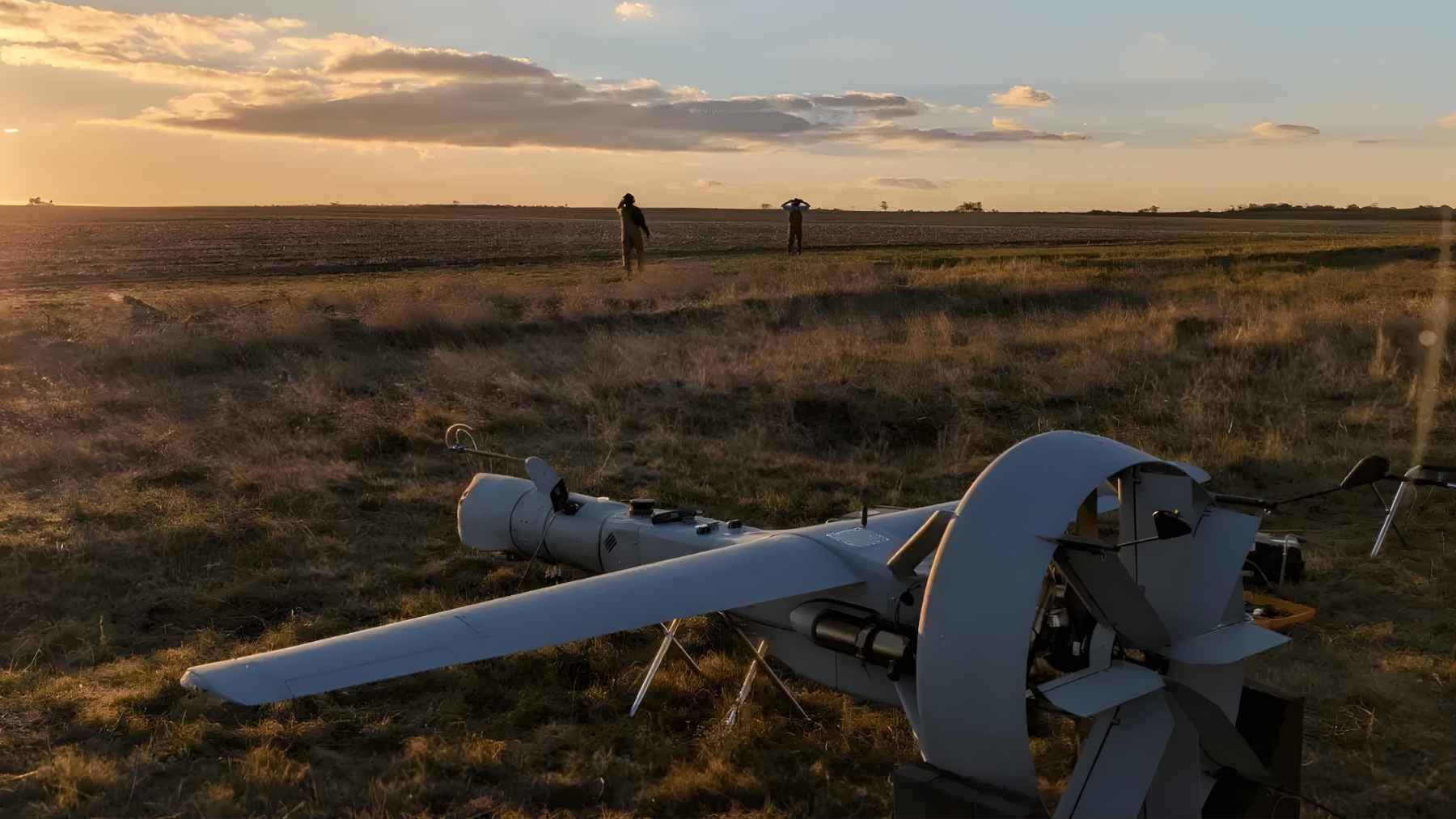
On the sharp end of this experiment sits a family of interceptor drones built on technology known as Octopus. According to Ukraine’s defense ministry and outside reporting, these drones are designed specifically to hunt Shahed type attack UAVs in mid air.
Each interceptor costs only a few thousand dollars yet can destroy incoming drones that are many times more expensive, which is why Ukrainian officials like to compare it to taking a rook with a pawn in chess.
Analyses of Ukraine’s procurement plans and statements from Kyiv describe a rapid scale up. In late 2025 the government announced that it had begun mass production of interceptor drones, based on the Octopus concept, to reinforce air defense.
The goal mentioned publicly is to field hundreds, and eventually around one thousand, interceptor drones per day. Ukrainian sources suggest that production lines in both Ukraine and allied countries are being prepared so that output can reach thousands of units per month.
Specialist outlets such as Defence UA note that these interceptors can carry electro optical, infrared, or thermal sensors and are being adapted to work hand in hand with the AI models developed inside the Dataroom.
The idea is that an interceptor launched from near a city or critical substation would already “know” how a Shahed looks and flies, even in cluttered or jammed conditions, because its guidance software was trained on thousands of real examples.
At the same time, Ukraine is reshaping its broader defense industry. Before the full-scale invasion, only a handful of companies produced small drones.
Officials now talk about hundreds of firms building uncrewed systems and other autonomous platforms, from ground robots to maritime drones.
That shift mirrors a wider global race, where countries are not only refining classic air defense but also rehearsing multi-domain operations in large exercises like ORION 26 and modernizing naval hubs with advanced sensors and digital twins, as seen in Spain’s F 110 frigate program.
What the AI shield can really do
Outside experts caution that talk of an “AI shield” can sound more sweeping than what Ukraine is actually building.
A recent editorial at Defence Matters argues that the current project is best understood as a data and software foundation rather than a fully autonomous national missile shield. In practical terms, it aims to standardize how wartime data is stored and used, then give vetted companies tools to develop smarter guidance and decision support for interceptor drones.
That may still be a big deal. If AI-assisted interceptors can reliably peel off hundreds of Shahed drones at a fraction of the cost of a surface-to-air missile, Ukraine can reserve its most expensive systems for cruise and ballistic threats.
For families in cities like Kyiv or Kharkiv, the difference will show up not in abstract diagrams but in how often the lights stay on and how many nights they spend listening to sirens in metro stations.
There are hard questions too. Training AI on real combat data means handling highly sensitive information about air defense tactics and vulnerabilities.
Ukrainian officials say access to the Dataroom is tightly controlled and that foreign partners are kept at arm’s length from the raw data. Human oversight also remains central, both to prevent technical mistakes and to keep humans in the loop on life and death decisions.
To a large extent, Ukraine’s AI air defense effort is one answer to a problem every military is now wrestling with.
Drones are cheap, flexible, and getting smarter. Defenders risk draining their budgets if they fire a six-figure missile at every buzzing object overhead.
From laser air defenses on warships to FPV swarms and recharging drones in flight, the world’s armed forces are testing new ways to flip that cost equation. Ukraine is simply doing it under the harshest possible stress test.
For now, the AI shield remains a work in progress rather than a magic dome. Yet if it can cut the number of drones that get through, protect power plants, and make it less likely that entire neighborhoods spend winter nights in the dark, it may reshape the political calculus in Moscow as much as the tactical picture over Ukrainian cities.
The official statement was published on Digital State UA.