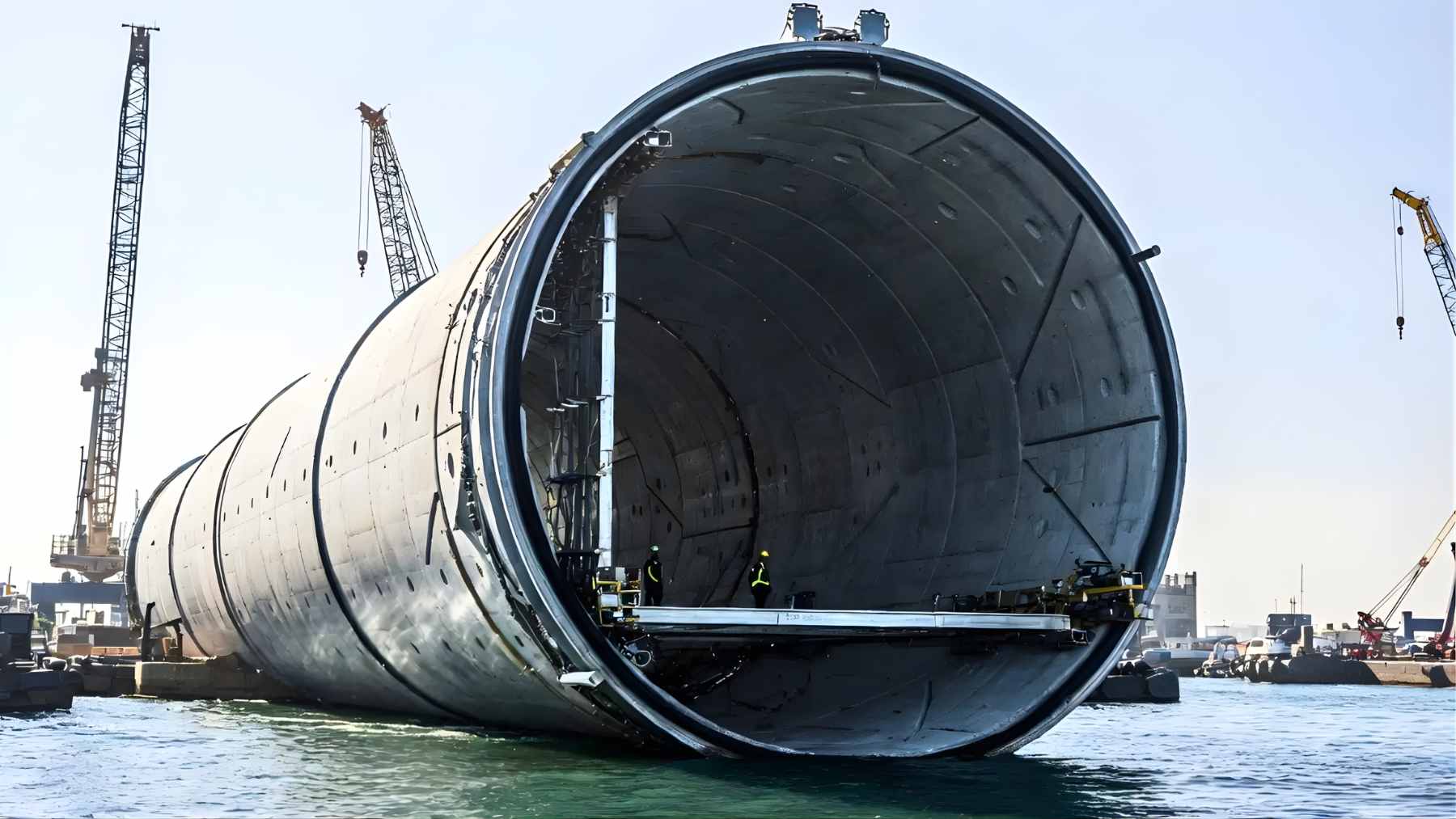
A submerged tunnel looks like a triumph of concrete and steel. In reality, the ocean is often kept out by something far less dramatic, a thick rubber gasket squeezed between massive tunnel elements.
New research suggests that rubber can lose sealing force far faster under real conditions than earlier projections implied. The tunnel may still stay watertight on paper, but the safety margin shrinks, and that has real consequences for coastal resilience, budgets, and the tech used to keep critical infrastructure safe.
A seal doing heavy work
In immersed tunnels, a GINA gasket and an internal “omega seal” are described by manufacturers as the barrier system that prevents water ingress from outside pressure.
Their design expectations are often framed around a 100-year tunnel lifetime, which sounds reassuring until you remember the ocean never takes a day off.
The construction method also explains why the rubber is under constant stress. Tunnel elements are built, floated, towed into place, lowered, and pulled together, then the water between bulkheads is pumped out so outside pressure compresses the gasket into a seal.
That compression is the whole trick, and also the whole vulnerability.
A bigger test, a smaller safety margin
A 2026 study in Tunnelling and Underground Space Technology looked at aging under two realities at once, long-term compression load and seawater exposure. The team tested the gasket at multiple scales, from macroscopic performance to microscopic morphology and molecular structure, to see what “aging” really means in a working tunnel.
The headline numbers are hard to ignore. The study reports Shore A hardness up 14.18% and density up 5.88%, yet contact stress attenuation of 67.66%, with long-term contact stress projected at 1.51 MPa after 100 years under compression plus seawater.
The authors flatly state that “the hundred-year waterproofing safety” is directly determined by the gasket, which is a strong way of saying this is not a minor component.
When harder rubber can still mean a weaker seal
Here’s the part that could fool routine inspections: a gasket that feels tougher can look healthy, but the study links the loss of sealing force to structural degradation inside the material, including molecular chain scission that steadily lowers key mechanical behavior.
The decline is not a smooth straight line, either. The researchers describe three phases, an initial steep drop, a long moderate decline, and a final gradual convergence, and they report measurable shifts during accelerated aging such as a glass transition temperature moving higher by 3.24° C after 90 days.
In other words, the gasket’s “feel” changes while the sealing performance quietly drains away.
The bottom edge problem is where leaks start
Another 2025 open-access case study, also using the Yuliangzhou immersed tunnel as context, gets more specific about how failure shows up at the joint.
It concludes that top contact stress significantly exceeds bottom contact stress, making the bottom the predominant leakage pathway, and it reports a limit joint opening of 47 mm for waterproof performance under the studied conditions.
This matters because deformation and aging stack on top of each other. The same study links joint rotation to changes in opening and contact stress, with a reported limit rotation angle of 0.41°, which points to a practical takeaway for operators: the geometry at the joint can push the weakest area closer to failure even before the gasket “looks” worn.
The environment angle people forget about
A leaking tunnel is not only a safety and service problem, it can become an energy problem. If water intrusion increases, pumping and maintenance rise, too, and that energy shows up somewhere, often in higher operating costs, and indirectly, a bigger footprint that eventually lands on ratepayers and taxpayers (the same people already staring at that summer electric bill).
Water pressure also sets the bar the gasket has to clear. A separate engineering analysis notes that minimum gasket compression is determined by water pressure, meaning higher water levels require higher minimum compression to maintain watertightness.
That is why a shrinking contact stress margin is more than an academic worry for coastal infrastructure.
Business and defense stakes are quietly tied to elastomers
From a business perspective, the story is less “the tunnel will fail tomorrow” and more “life-cycle assumptions are shifting.”
Earlier seawater-focused aging work reported contact stress projected at 2.32 MPa after 100 years, while the compression-plus-seawater study projects 1.51 MPa, which reframes how operators think about inspection intervals, replacement planning, and risk pricing.
There’s also a security and continuity angle that rarely gets discussed outside engineering circles. Submerged crossings can be single points of failure for port access, emergency response routes, and regional logistics, and defense planners tend to care a lot about anything that quietly narrows operational margins over decades.
One worn gasket will not make headlines–until the day it does.
The next wave of tunnel tech looks like monitoring, not guesswork
So, what changes now? One obvious shift is moving away from eyeballing rubber hardness and toward measuring deformation and sealing performance proxies that actually correlate with risk.
An open-access 2023 paper in the same journal describes a distributed optical fiber sensing system designed to monitor immersed tunnel joint deformation, with in-lab verification for sub-millimeter accuracy, and it notes that conventional manual leveling can happen only at multi-year intervals.
Put those pieces together and the direction is clear. Better aging tests that include real compression loads, plus continuous deformation monitoring, can turn “100 years” from a slogan into an actively managed durability plan, especially at the bottom edge where problems like to begin.
The study was published on ScienceDirect.