Solar power is everywhere, but it still has a timing problem. A Harvard engineering team has demonstrated a “dual-mode” solar harvester that automatically routes sunlight as electricity when it is warm and as useful indoor heat when temperatures drop.
What if a panel could decide that for you, with no apps and no settings? That is the core idea here, and it could help cut emissions while taking some strain off the grid during heat waves and cold snaps, when the electric bill tends to hurt the most.
A panel that switches itself
The prototype comes from the lab of Harvard materials scientist Joanna Aizenberg, and it was described in a new study highlighted by Harvard’s Salata Institute in March 2026. Lead author Raphael Kay says “the switching capacity is calibrated to seasonal building needs, which are temperature dependent.”
Here is the unusual part: it does not rely on sensors, motors, or software logic, so it can flip modes without a controller box or extra wiring on the roof. It simply switches when the surrounding temperature crosses a dew point.
Buildings are the target
Buildings are a climate heavyweight, largely because they burn so much energy just to stay comfortable. The International Energy Agency estimates that building operations account for about 30% of global final energy consumption and 26% of global energy-related emissions.
Heat is a big reason why. REN21 reports that heat represents about 74% of buildings-sector energy use, while space cooling is the fastest-growing end use, rising around 4% per year on average since 2000. In practical terms, that means winter freezes and summer heat are both getting harder to manage, even as grids try to get cleaner.
The water switch, explained
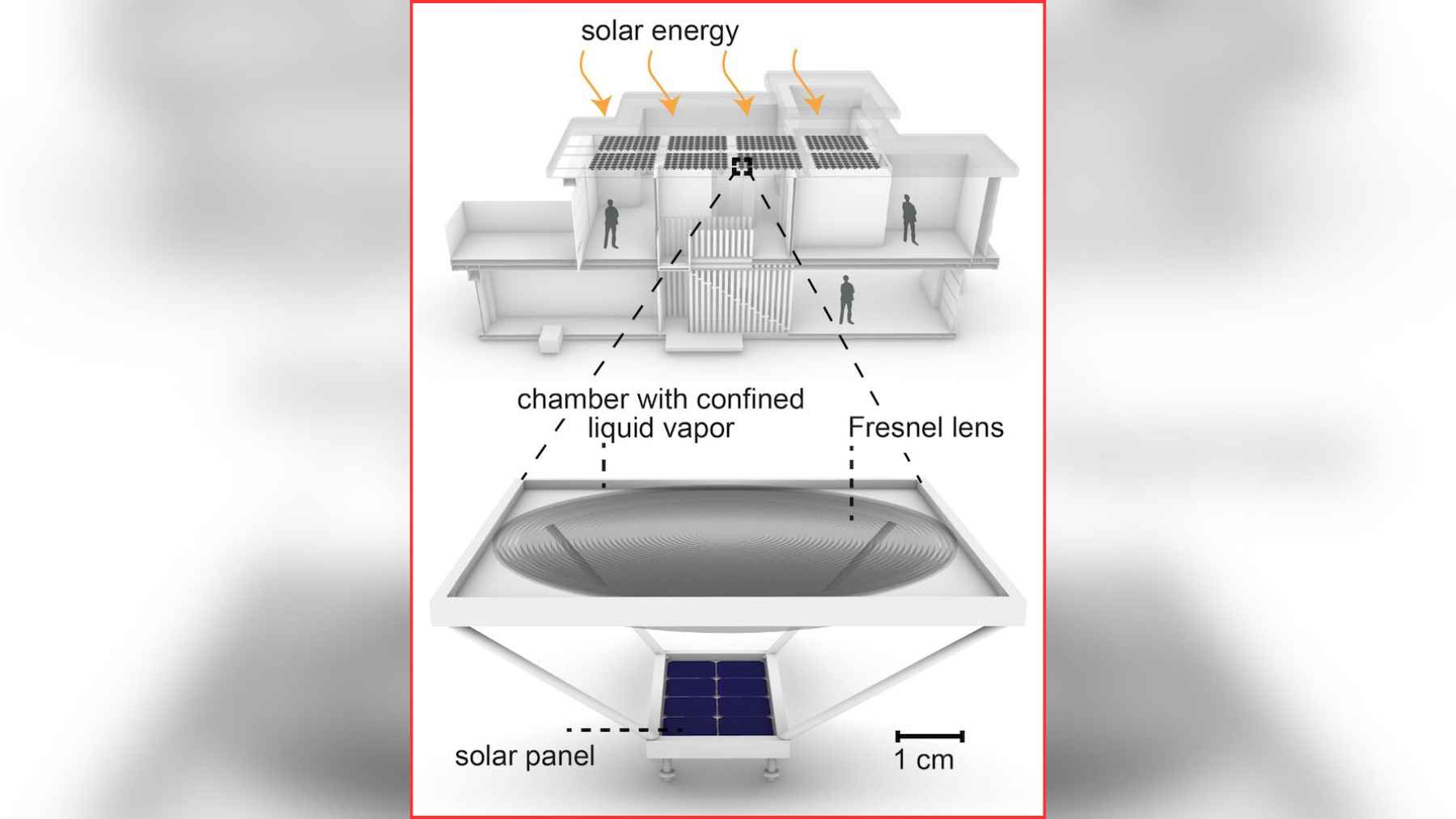
Think of the device like a tiny solar switchboard. It uses a Fresnel lens, which is a thin, ridged lens that concentrates sunlight, plus a sealed cavity that holds a fixed amount of water above the lens and a small photovoltaic cell below it.
When the water stays as vapor, the optics favor focusing sunlight onto the photovoltaic cell, so electricity production dominates. When the cavity cools and water condenses into a thin layer, the focusing power drops and more light passes through into the indoor space, where it becomes heat. No electronics needed, just evaporation and condensation doing the work.
The lab results and the fine print
In one demonstration, the enclosed air had a dew point close to 15 C (59 F), so the mode shift happened when the lens dropped below that temperature. The Salata Institute write-up notes that, using Boston’s average seasons as a guide, electricity would dominate from May to October and heat would dominate from November to April, and that humidity changes can move the crossover point.
The measured performance is what makes the concept worth watching. In heating mode, the system converted about 90% of incident sunlight into indoor heat, and Kay estimated this could be roughly five times the solar-heating yield of pairing a standard photovoltaic panel with resistance heating.
The same lab setup saw the indoor temperature fall from about 25 C (77 F) to about 22 C (72 F) as simulated outdoor temperature rose from 10 C (50 F) to 35 C (95 F), while relative light intensity on the photovoltaic cell increased by roughly 50%.
Business stakes for real estate and the grid
For builders and building owners, the promise is not “maximum electricity at all hours.” It is better matching, so a facade element can lean toward electricity on hot days when air conditioning demand spikes, then act more like a solar heater when it is cold. That kind of load shaping is valuable for landlords, utilities, and anyone dealing with peak pricing.
Aizenberg points to a commercial path, calling it “a component that can be laminated into skylights or facades” and linking the idea to rising cooling demand on a warmer planet. Still, the hard questions come next, including cost per square foot, durability under dust and weather, and how building codes will treat a hybrid of window, thermal collector, and solar generator. That is where climate tech wins or loses.
Why defense planners are watching
This kind of passive hardware also fits a defense conversation that has been getting louder: energy as a vulnerability. The Department of Defense’s 2023 Operational Energy Strategy highlights reducing operational energy demand and diversifying energy sources to reduce risk and improve effectiveness, especially in contested environments.
There is a reason the topic keeps resurfacing. In a 2009 U.S. Army article, the service said a one-percent reduction in fuel consumption in Iraq or Afghanistan could have meant roughly 60 fewer long-distance fuel convoys per year, and noted that a typical fuel convoy can involve 50 to 100 soldiers, which is why bases keep looking for distributed energy options.
The study was published on “Proceedings of the National Academy of Sciences”.