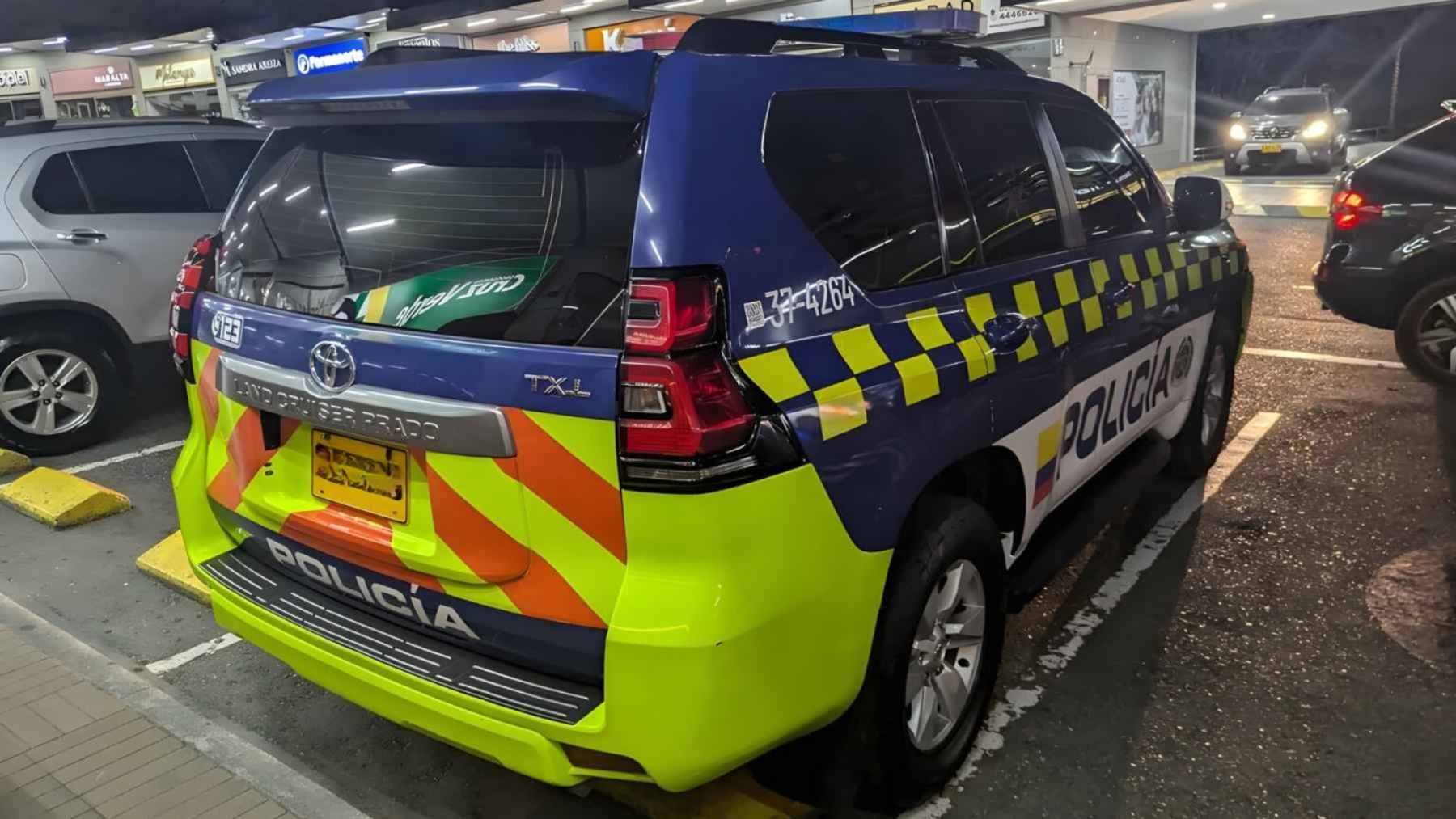
Colombia’s National Police have added four Toyota Land Cruiser Prado SUVs in the diesel TX version, newly armored by local defense firm Armor International for senior staff transport in Bogotá.
The upgrades include “NIJ III” ballistic protection, reinforced multilayer glass, structural reinforcements, and “run-flat” tires meant to keep the vehicles moving even after taking hits.
That is the visible story–protection and mobility. But what happens when safer cabins mean heavier vehicles, and heavier vehicles mean more fuel use and more particulate pollution around busy roads? Even a security fleet can end up in the middle of an air quality debate.
What was delivered and why it matters
Infodefensa reports the vehicles received “NIJ III” armoring using special steel ballistic panels, high-resistance composite materials, and reinforced glass installed in doors, sides, the roof, and other critical zones.
It also notes structural reinforcements and overlapping panels around door seams, plus “run-flat” tires to preserve mobility after impacts or a loss of pressure.
The stated goal is to protect occupants against gunfire while maintaining enough mobility to leave a danger zone. The report describes the armor level as able to stop 7.62x51mm NATO and 7.62x39mm rounds, along with handgun ammunition, by absorbing and dispersing energy across multiple layers.
“NIJ III” is more than a label
“NIJ” refers to the U.S. National Institute of Justice, which publishes standards and specifications that define ballistic protection levels and the associated test threats. NIJ Standard 0123.00 aims to unify protection levels across ballistic-resistant products used by law enforcement and connect them to specific rounds and test conditions.
In that framework, older “Level III” language maps to a rifle protection category called “RF1.”
For buyers, that can be the difference between a reassuring sticker and a measurable performance promise. If a purchase only specifies “level” language without documentation of test threats and installation practices, it gets harder to compare bids and audit safety claims later.
Armor weight has a fuel and emissions price tag
Armoring is a life-saving technology, but it tends to make a vehicle heavier. And physics does not negotiate, more mass takes more energy to accelerate, brake, and push through traffic.
The U.S. Department of Energy notes that an extra 100 lbs. in a vehicle can reduce fuel economy by around 1%, with the impact depending on how the added weight compares to the vehicle’s baseline. In a place where traffic can crawl and engines idle in that oppressive summer heat we all know, small percentage losses can turn into real fuel burn over time.
Idling is the other trap door. DOE guidance says idling can use about a quarter to a half gallon of fuel per hour, which is why driver training, dispatch rules, and anti-idling habits can matter even when the vehicle itself cannot be easily redesigned.
Bogotá’s clean air push raises the stakes
Bogotá is not treating air quality as an abstract environmental issue. The World Resources Institute has pointed to estimates of around 2,300 excess deaths in 2019 tied to the city’s poor air quality, and it notes that Bogotá’s 2023 average PM2.5 level measured more than three times the World Health Organization recommended limit.
On the policy side, a C40 report says Bogotá’s Plan Aire 2030 targets an average annual PM2.5 concentration of 15 µg/m³ by 2030. The OECD’s 2026 environmental review of Colombia also flags transport as a major contributor to pollutants like nitrogen oxides, non-methane VOCs, and carbon monoxide.
So when new diesel SUVs enter a city fleet, even in small numbers, people will ask reasonable questions: how much will they be used, how long will they idle, and what policies keep the environmental impact from quietly growing year after year?
The pollution you cannot see in the exhaust
Tailpipe emissions are only part of the urban air story. The OECD notes that non-exhaust particulate emissions from tires, brakes, road wear, and resuspended dust remain significant, and heavier vehicles can increase some of these emissions through greater wear.
A 2025 report produced with EIT Urban Mobility describes brake wear as a major source of non-exhaust emissions in cities and notes that regenerative braking can cut brake wear dramatically. That is one reason electrification and smarter driving patterns can still improve urban air quality, even as fleets become heavier for safety or capability reasons.
A greener way to buy and run protective fleets
None of this argues against protection. It argues for treating protective vehicles as part of a city’s emissions inventory, not as a separate category that escapes scrutiny.
In the near term, the biggest wins can be boring but effective: strict anti-idling rules, maintenance that keeps tires properly inflated and aligned, and route planning that avoids the worst congestion when possible.
Over the longer term, agencies can ask suppliers for lighter ballistic material options where feasible and can publish fuel and maintenance data so trade-offs are measured instead of guessed.
Security and sustainability are now sharing the same road.