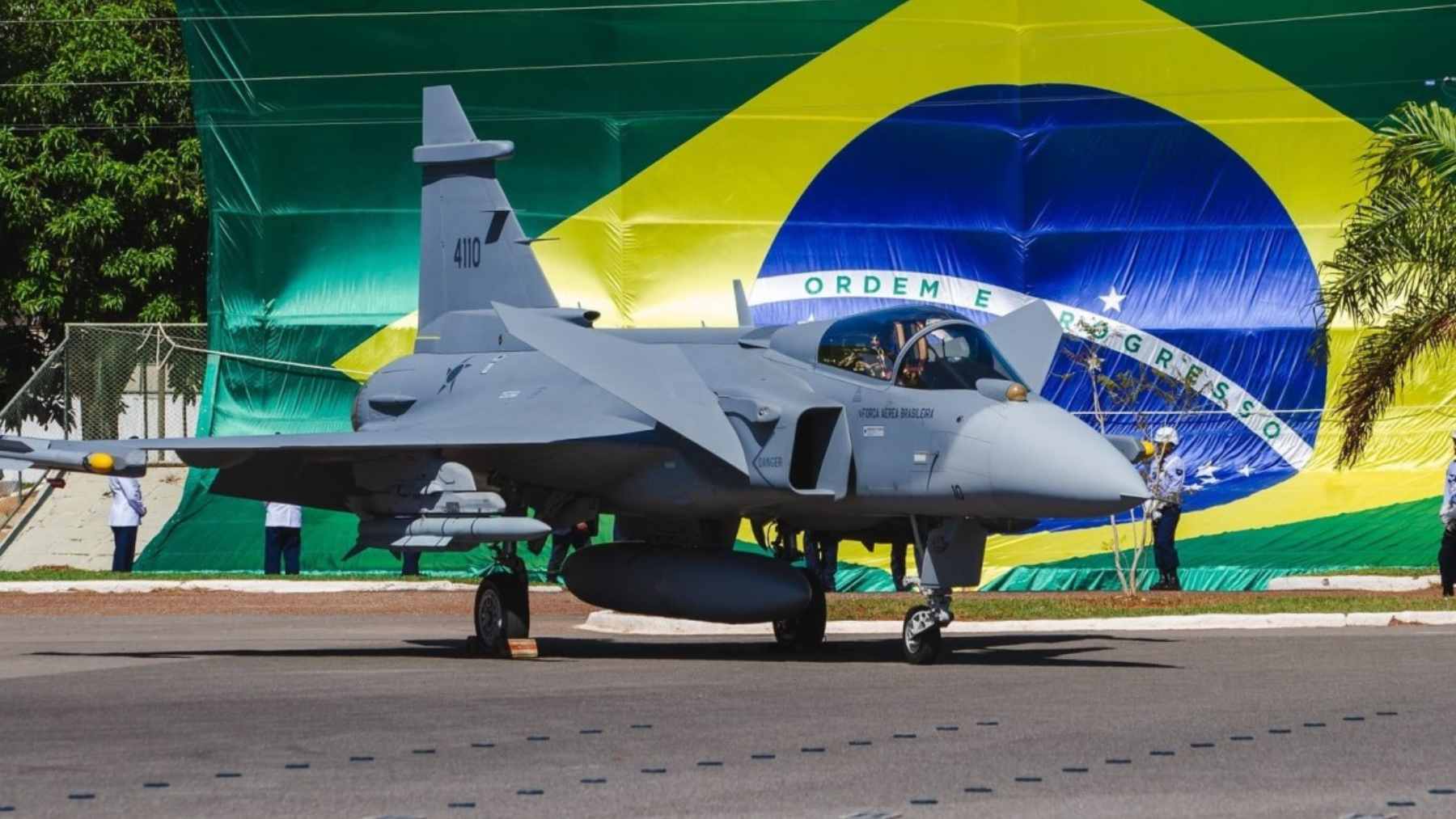
Brazil has just crossed a major aerospace threshold. On March 25, 2026, Embraer, Saab, and the Brazilian Air Force rolled out the first Gripen E produced in Brazil at Embraer’s Gavião Peixoto site in São Paulo state, with President Luiz Inácio Lula da Silva at the ceremony.
It is an unmistakable defense headline, but there is a quieter environmental one riding in the back seat. Fighter jets run on fossil jet fuel, and the global climate footprint of militaries is far from small.
Brazil’s push to localize high-end aircraft production now collides with another national ambition: using biofuels and sustainable aviation fuel to cut transport emissions.
A new fighter line with export ambitions
Brazil signed for Saab’s Gripen in 2014, choosing it over other Western fighters to replace an aging fleet, and the plan included technology transfer and local assembly. Reuters reports that 15 of the 36 aircraft in the contract are set to be produced at Embraer’s Brazilian plant, making Brazil the first Latin American nation to assemble a supersonic fighter jet.
Saab is leaning into the business upside. In its own statement, the company said it wants Brazil to deepen industrial and technological capability and act as an “export hub to the world,” and Reuters pointed to Colombia’s agreement to acquire Gripens as a boost for that plan.
This production model is already broader than a single airframe. Saab says the Gavião Peixoto line uses a Brazilian and international supply chain, and the new jet will be tested before joining operational aircraft at Annapolis Air Force Base.
Saab also describes Gripen E as a multi-mission aircraft built around networked avionics and sensor fusion that supports information sharing across formations.
The military emissions gap is real
Ask someone where aviation emissions come from and they might think of crowded airports and long haul vacations. Defense aviation usually does not come up, even though military operations burn fuel at scale and often sit in a reporting gray zone.
A 2022 report by Scientists for Global Responsibility and the Conflict and Environment Observatory estimated the total global military carbon footprint at about 5.5% of global emissions, roughly 3,000 million tons of CO2 equivalent.
The authors add that if the world’s militaries were a country, that footprint would rank around fourth globally.
That number is not just about jets in the sky. The estimate includes supply chain emissions, which matters when a country builds a new fighter production line and then tries to scale it for exports.
Brazil’s biofuel push is landing in aviation
Brazil is not entering this moment empty-handed on clean fuels. The country’s “Fuel of the Future” agenda includes a National Sustainable Aviation Fuel Program called ProBioQAV for domestic civil aviation.
According to Brazil’s Ministry of Mines and Energy, beginning in 2027 airline operators will be required to reduce greenhouse gas emissions on domestic flights through SAF, starting with a 1% reduction and rising gradually to 10% by 2037.
The same policy package also raised mandated blends to E30 for ethanol in gasoline and B15 for biodiesel in diesel. The ministry said the shift to E30 alone could drive more than R$10 billion (USD $1.9 billion) in investments and lower gasoline prices at stations by as much as 20 cents.
Will that spill into defense aviation too? Not automatically, since these targets are written for civilian operators, not air forces. But a bigger SAF market changes what is available at the refinery and airport, and aviation groups say SAF can cut lifecycle CO2 emissions by up to 80%, depending on feedstock and production pathway.
Cleaner manufacturing is the easier part
There is a reason climate discussions keep circling back to supply chains. It is generally simpler to decarbonize a factory’s electricity than it is to decarbonize a combat aircraft that must prioritize range, readiness, and performance.
Still, local production shifts some of the environmental choices closer to home. Energy use at industrial sites, sourcing of high-value materials, and logistics across Brazil’s supply chain can all move the needle on embedded emissions as buyers and investors ask for clearer reporting.

That is where policy and business start to overlap. Biofuels can change what shows up at the pump, and cleaner industrial power can matter for local air quality in places that already feel the dry-season heat.
What readers should keep an eye on next
The next milestones for Brazil’s Gripen program will be operational, not just industrial. Saab says the aircraft began Quick Reaction Alert missions from Annapolis in February, a reminder that these jets are built to fly when the security environment demands it.
On the climate side, the more revealing signal will be disclosure: whether defense agencies publish clearer fuel use and emissions data, and whether procurement contracts begin to treat lifecycle emissions as a measurable cost alongside dollars and performance.
Brazil’s new fighter line is a symbol of strategic autonomy, but it also spotlights a hard reality.
The press release was published on Saab.