A small DIY project in Florida is a reminder that cooling is no longer just about comfort. It is becoming a real stress test for power grids and a bigger piece of the climate story.
Instead of saving solar power in lithium cells, one hobbyist used sunlight to freeze water. Later, that stored ice delivered up to 700 watts of cooling without pulling from the grid, a practical twist on thermal energy storage that the U.S. Department of Energy has been pushing for buildings.
The bigger problem behind the gadget
Air conditioning already accounts for about 10% of global electricity use, and demand is climbing as heat waves intensify and more people can afford cooling.
That growth is good for health and productivity, but it pushes utilities toward expensive peak capacity that may run only a few days a year, according to the International Energy Agency.
That peak is not just a business headache. In early-summer heat waves in 2025, France saw evening electricity peaks 25% above its off-season average, and New York saw peaks 90% higher, according to the International Energy Agency.
Ice as a “thermal battery”
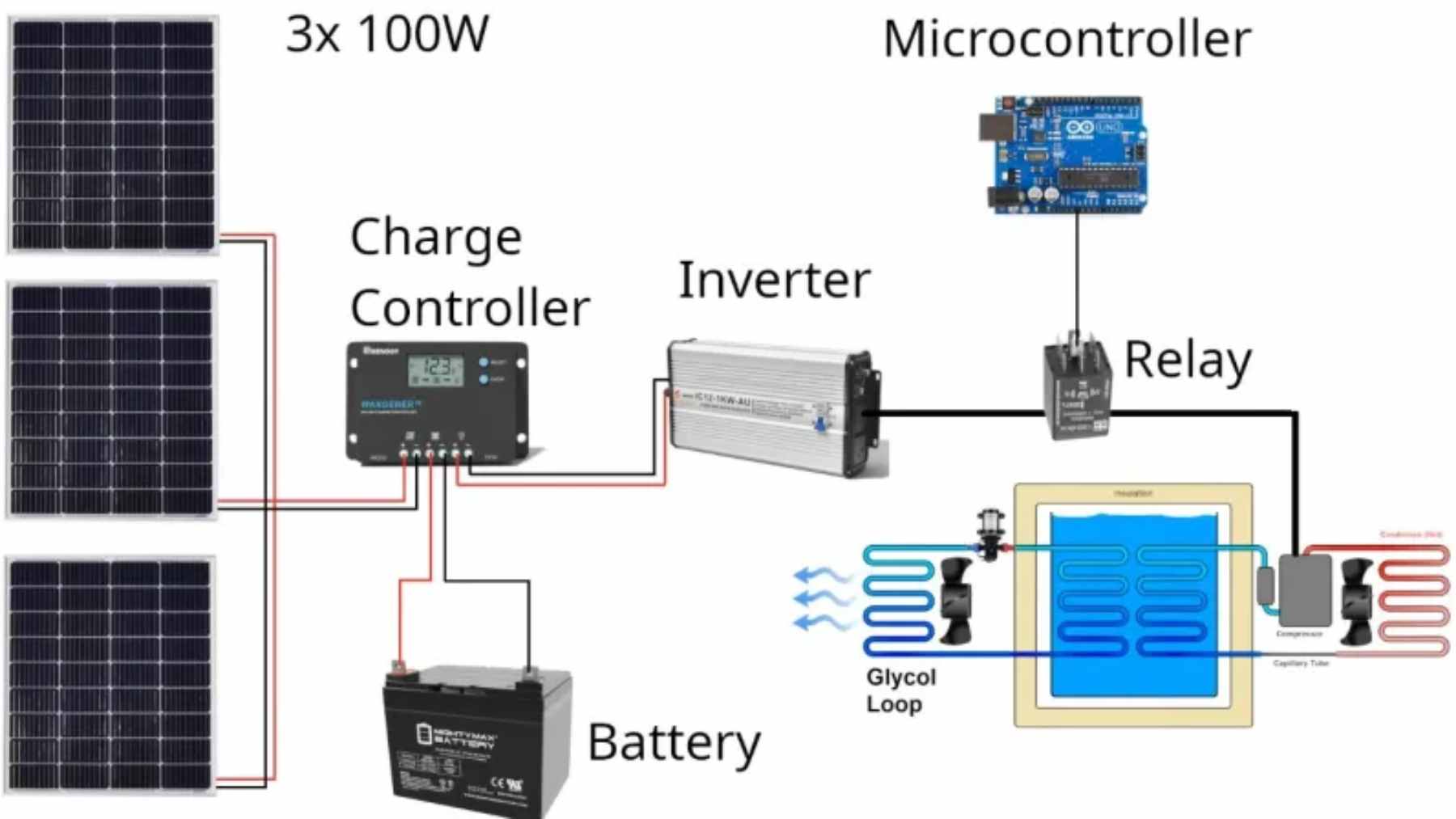
The Florida build uses three 100-watt solar panels, a compact compressor, copper coils, and an insulated tank to freeze water during sunny hours. When the sun fades, a separate loop circulates antifreeze through the ice block and a small radiator with a fan, moving that stored cold into a tiny cabin-like space.
In technical terms, it is a vapor-compression cooling cycle paired with phase-change storage. The trick is not exotic materials, it is timing. Make the cold when solar power is abundant, then spend it later when the grid is stressed and your electric bill is highest.
Why the U.S. Department of Energy cares
This is basically the logic behind ice storage systems that have been used in large buildings for years. The U.S. Department of Energy describes ice storage as one of several thermal storage approaches that can “charge” off-peak and reduce HVAC electricity during high demand.
DOE-funded work also puts numbers on the appeal. In one SBIR-backed project, DOE notes that integrating an HVAC thermal storage scheme can add roughly $800 to $2,500 to a new system, with possible payback as low as two to four years depending on time-of-use rates.
For households, that matters because more than 45% of electricity consumed in U.S. buildings goes to thermal uses such as air conditioning and water heating. Shifting even a slice of that load can lower peak prices and keep more flexibility in the system when extreme heat hits.
A defense angle that rarely makes the headlines
Cooling is also a quiet logistics problem for militaries. The U.S. Army has tested “Improved Environmental Control Unit” upgrades and microgrid controls to cut the fuel burn that keeps tents livable, because every fuel convoy is a cost and a risk.
Thermal storage fits that world surprisingly well. A container of ice or other phase-change material can let generators run at steadier, more efficient levels, while still delivering cooling during the hottest part of the day.
For permanent installations, the conversation gets more formal. U.S. federal construction guidance for chilled water thermal energy storage spells out design and commissioning expectations, which shows how “ice batteries” have moved from novelty to normal engineering in the right settings.
The refrigerant question
It is not only about kilowatt-hours. Air conditioners also rely on refrigerants, and some of the most common ones have high global warming potential if they leak.
That is why regulation is tightening. The European Union’s 2024 F-gas rules strengthen phase-downs of fluorinated greenhouse gases and push the market toward lower-impact refrigerants and tighter controls across the supply chain.
For builders and buyers, the near-term takeaway is simple. Efficiency and refrigerant choice are becoming linked decisions, and systems that can reduce run-time during peak heat may also reduce leak risk over a unit’s lifetime.
What this Florida experiment gets right, and what it does not
The upside is straightforward. Using ice shifts load away from the afternoon peak and makes solar power feel useful after sunset, which is exactly when many grids struggle most.
But the limits are real. The setup is heavy, it needs serious insulation, and real-world humidity can swallow a lot of cooling power before a space feels comfortable.
And then there is safety. A DIY rig with compressors, refrigerant, wiring, and plumbing is not a toy, and scaling it into a product requires certifications, leak management, and careful design.
The business opportunity hiding in plain sight
The business case is not just for homeowners. Utilities and building owners are increasingly paying for flexibility, and thermal storage is one of the cheapest ways to provide it when the end use is cooling.
Industry groups like ASHRAE have been tracking improvements in “cool thermal energy storage” and how better controls make ice storage more practical alongside heat pumps and modern building automation.
If that sounds abstract, think about the buildings you use every week. Grocery stores, schools, data centers, and hospitals all fight the same summer heat, and many of them pay a premium for peak electricity they would love to avoid.
At the end of the day, the Florida ice battery is a small prototype with a big message. Cooling demand is rising faster than grid upgrades, and sometimes the simplest storage medium is the one already in your freezer tray.
The official commentary was published on International Energy Agency.