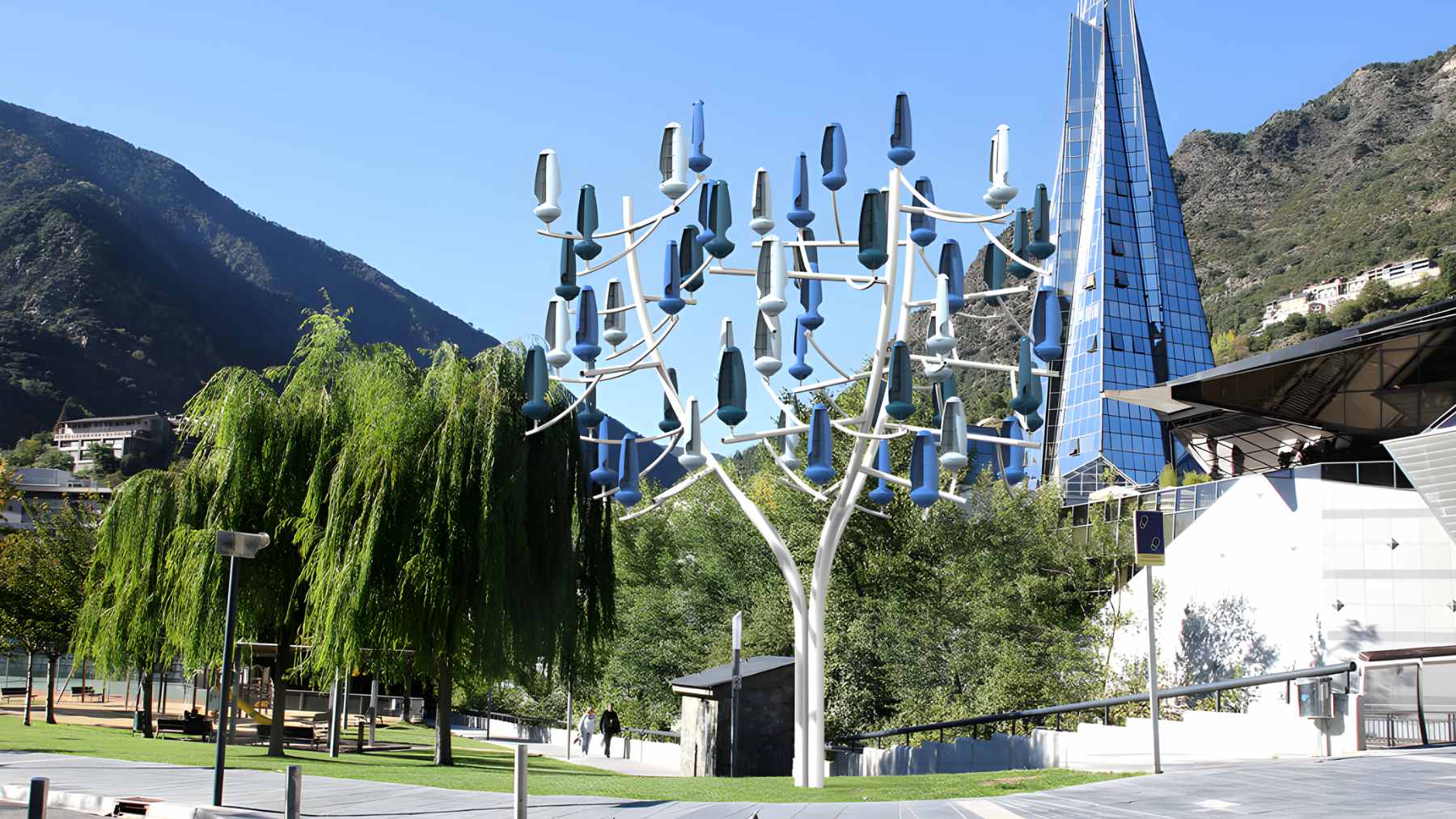
A homeowner in Lower Saxony, Germany, has installed a nearly 33-ft. steel “wind tree” in his yard, a sculpture-like mast that holds 36 small turbines shaped like leaves. Sebastian Harms says the plan is to pair it with his existing solar panels to cover his home, office, and electric car, with the bigger goal of full energy self-sufficiency by 2029.
IRENA says global renewable power capacity reached 5,149 gigawatts at the end of 2025, but households still worry about the monthly bill and whether the grid can keep up.
Could a tree-shaped turbine in the yard keep the lights on and charge an EV overnight when the sun goes down? Harms’ project shows what distributed wind gets right and where it can fall short, because without good wind, the payback can collapse.
A wind turbine that blends into the neighborhood
Focus Online describes the installation in Thüdinghausen as a 32’10” steel trunk with 36 green microturbines mounted on branching arms, set on a concrete foundation and weighing roughly 3.9 tons.
The company’s data sheet lists it at 7,915 lbs. excluding the base anchor, and Focus Online says the height stayed under a 50-ft. threshold so it did not need a building permit in Lower Saxony.
New World Wind’s data sheet lists 10,800 watts of installed power for a 36-leaf model and a lower nominal power figure of 5,868 watts. That gap is a reality check, and the company’s CEO told local media more than 200 of these “wind trees” are already deployed worldwide.
Why Harms wants wind when solar is off
Harms already has two solar PV systems rated at up to 10,000 watts each, and he told local media he expects the wind tree to make his property more energy independent. Focus Online says his logic is that wind can keep producing when solar is weak, especially at night or during gray winter stretches when the sun barely shows up.
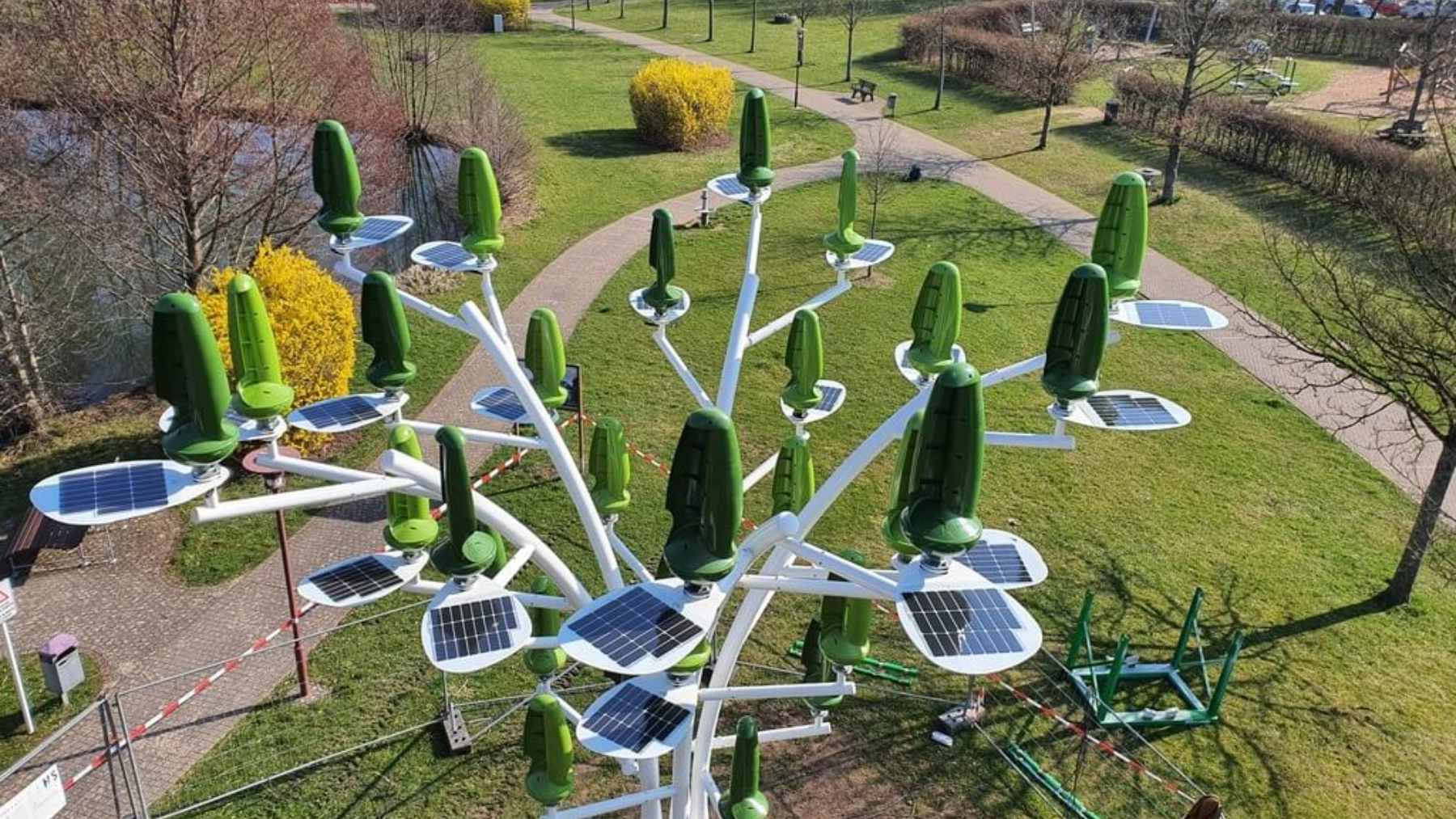
This is the practical pitch for a hybrid home setup, you stack sources that behave differently across the day and across the seasons. New World Wind also sells hybrid versions that add small photovoltaic “petals” to its wind devices, aiming for extra output in sunny locations.
Real output depends on wind, not wishful thinking
Each “Aeroleaf” is designed to operate independently, so one failure should not stop the rest from generating. New World Wind says each unit is rated at 300 watts and is designed to start turning at wind speeds of about 8 ft. per second, which is lower than many conventional large turbines.
Still, small wind is famously site sensitive. Focus Online notes that experts often warn profitability depends heavily on the local wind resource, and it cites concerns that in poor locations the cost of generated electricity can exceed €1 per kilowatt-hour, making a 20-year payback hard to reach.
The payback problem is hard to ignore
Focus Online puts the total investment for Harms’ wind tree at around €70,000 ($80,800) including foundation and electrical work, and it contrasts that with a full home solar installation in Germany that it says can come in under €20,000 ($23,000).
Even before maintenance, that price gap sets a high bar for small winds to clear.
Electricity rates explain why people are tempted anyway. Eurostat shows Germany had the EU’s highest household electricity prices in the first half of 2025 at about €38 ($44) per 100 kWh, and Germany’s grid regulator has modeled new-customer prices in the mid 30 cents ($0.345) per kWh range. The wind will decide whether those savings ever catch up to the upfront cost.
What this has to do with defense and energy security
The consumer story overlaps with a security story, because energy reliability is now treated as a resilience issue. NATO points out that energy developments affect the security environment and that dependable, diversified supply matters for resilience against political and economic pressure.
On the ground, that looks like microgrids and on-site generation that can keep critical operations running when the wider grid is disrupted. In 2025, NAVFAC described a microgrid project at Naval Air Station Sigonella that includes photovoltaic panels, battery storage, and a control system as part of an effort to boost energy security.
What to watch before “wind trees” go mainstream
For homeowners, the next question is measurement. Focus Online reports that Harms plans to analyze the system’s actual electricity feed-in, and that kind of real performance data is what will determine whether these devices stay a niche product or become a repeatable solution.
For policymakers and buyers, standards matter as much as design. The International Code Council’s small wind certification program points to IEC standards used to assess wind turbine performance and other characteristics, helping separate tested equipment from flashy claims.
At the end of the day, Harms’ backyard experiment is a reminder that the clean-energy transition is not only about big wind farms and solar fields, it is also about what people will accept near their homes and how much they are willing to pay for control.
The official technical data sheet for the “WindTree” was published on New World Wind.