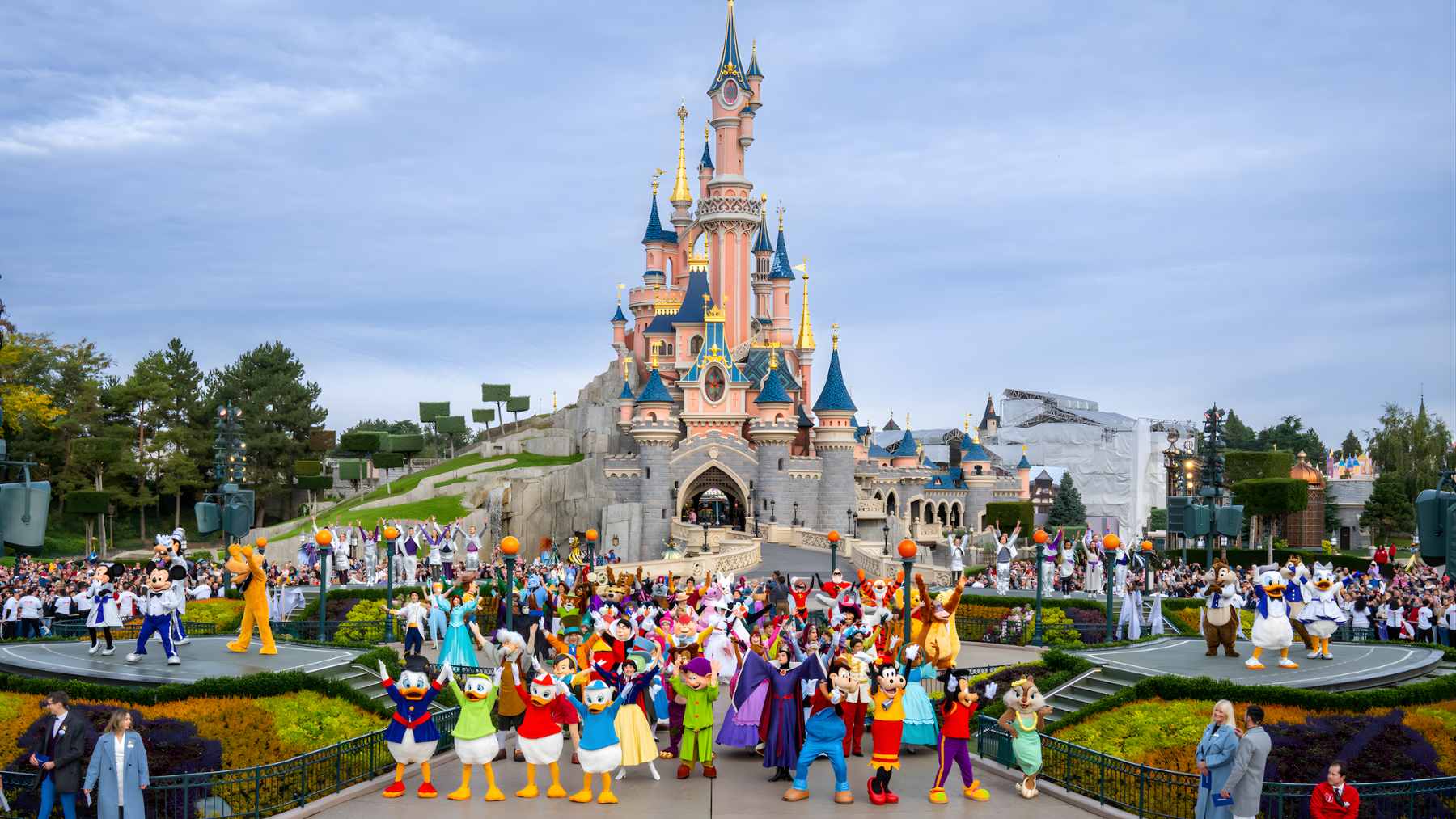
Families arriving at Disneyland Paris during this year’s spring break wave say they were stopped at the gates after the resort hit its attendance limit. Multiple Disney-focused outlets pointed to visitor posts showing the dreaded “Parks Are Full” message, with disappointed guests forced to rework plans they thought were locked in.
It sounds like a simple crowd story, but it also doubles as a snapshot of how modern tourism is colliding with environmental reality.
When demand spikes hard enough to trigger capacity caps, the pressure lands on energy, water, waste, transportation, and public safety all at once. And that’s where the environment stops being a side topic and becomes the main plot.
Crowds are back, and they are concentrated
The attractions industry has been moving back toward steadier growth, not just in raw attendance but in how travel demand clusters around peak dates. The Themed Entertainment Association said the combined attendance of the world’s top 25 theme parks rose 2.4% in 2024 to nearly 246 million visits.
In Western Europe, that “busy weekend” effect hits harder because options are fewer and travel is often cross-border. One widely cited attendance roundup based on TEA and AECOM data puts Disneyland Park at Disneyland Paris at 10,214,000 visits in 2024, with Walt Disney Studios Park at 5,598,000.
Reservations do not equal entry
Disneyland Paris is fairly blunt that “capacity” is not a vibe, it’s an operational limit. In its official FAQ, the resort says maximum capacity is based on how many visitors the parks can accommodate “while maintaining satisfactory conditions,” and it depends on factors like the number of attractions available and that day’s opening hours.
The fine print matters, too, especially when people assume a reservation is a guarantee. In the resort’s Advance Park Reservation System terms, Euro Disney says it can cancel park reservations “without liability” if capacity limitations result in the limit being exceeded, and it also notes that offerings are not guaranteed.
Even the ticket flow hints at the same reality. Disneyland Paris warns that certain ticket types require registering a visit date in advance, and that availability depends on park capacity.
The climate math behind a full park
There is a part most travelers do not want to think about while packing mouse ears. A 2024 study in Nature Communications estimated global tourism emissions grew 3.5% per year from 2009 to 2019, reaching 5.2 gigatons of CO2 equivalent in 2019, which puts it at 8.8% of total global greenhouse gas emissions. That is 5.2 billion metric tons, or about 5.7 billion U.S. tons.
The same paper says efficiency gains were modest, around 0.3% per year, while tourism demand growth ran hotter at 3.8% per year. In practical terms, cleaner tech helps, but demand spikes still drive the footprint, especially when everyone travels on the same few weekends.
If you have ever sat in a traffic jam outside a major attraction with the engine idling, you’ve seen the problem in miniature. Concentrated demand creates concentrated emissions, and it also strains local infrastructure that has its own climate and energy goals.
Disneyland Paris is building greener infrastructure
To its credit, Disneyland Paris has been investing in the less glamorous side of sustainability, the stuff visitors barely notice until it’s missing. The resort says it completed one of Europe’s largest solar canopy plants over its guest parking area, covering 11,200 parking spaces and producing about 36 gigawatt hours of electricity per year, which is 36 million kilowatt hours.
It also says the project aims to cut emissions in the Val d’Europe area by about 890 metric tons of CO2 per year (roughly 980 U.S. tons), and it notes more than 500 electric charging points in the parking lot.
Water is another pressure point that gets sharper as heat waves become more common. Disneyland Paris says it was the first theme park in Europe to install its own wastewater treatment plant in 2013, collecting up to 3,500 cubic meters per day, which is about 925,000 gallons, and reusing the treated water for cleaning roads and watering green spaces.
In a separate World Water Day post, the resort said an “intelligent” toilet flush system saved 188,000 cubic meters of drinking water in 2024, about 49.7 million gallons, and that it has reduced drinking water consumption by 24% since 2012.
Tech is becoming an environmental lever
Capacity systems can feel like a buzzkill, but they are also a kind of climate tool when they are used well. Better forecasting and smoother arrival patterns can reduce the “all systems maxed out” hours that drive up electricity use for cooling, refrigeration, lighting, and pumping water, especially during that sticky summer heat we all know.
Disneyland Paris also points to the transportation side, which is often the biggest slice of a visitor’s footprint.
On its environmental responsibility page, the resort says it promotes public transportation with partner SNCF Connect and claims taking the train in France cuts CO2 equivalent emissions by an average of 90% compared with an equivalent journey by car or plane.
That is a big portion, and it’s also a reminder that the greenest upgrade is sometimes just avoiding the tailpipe.
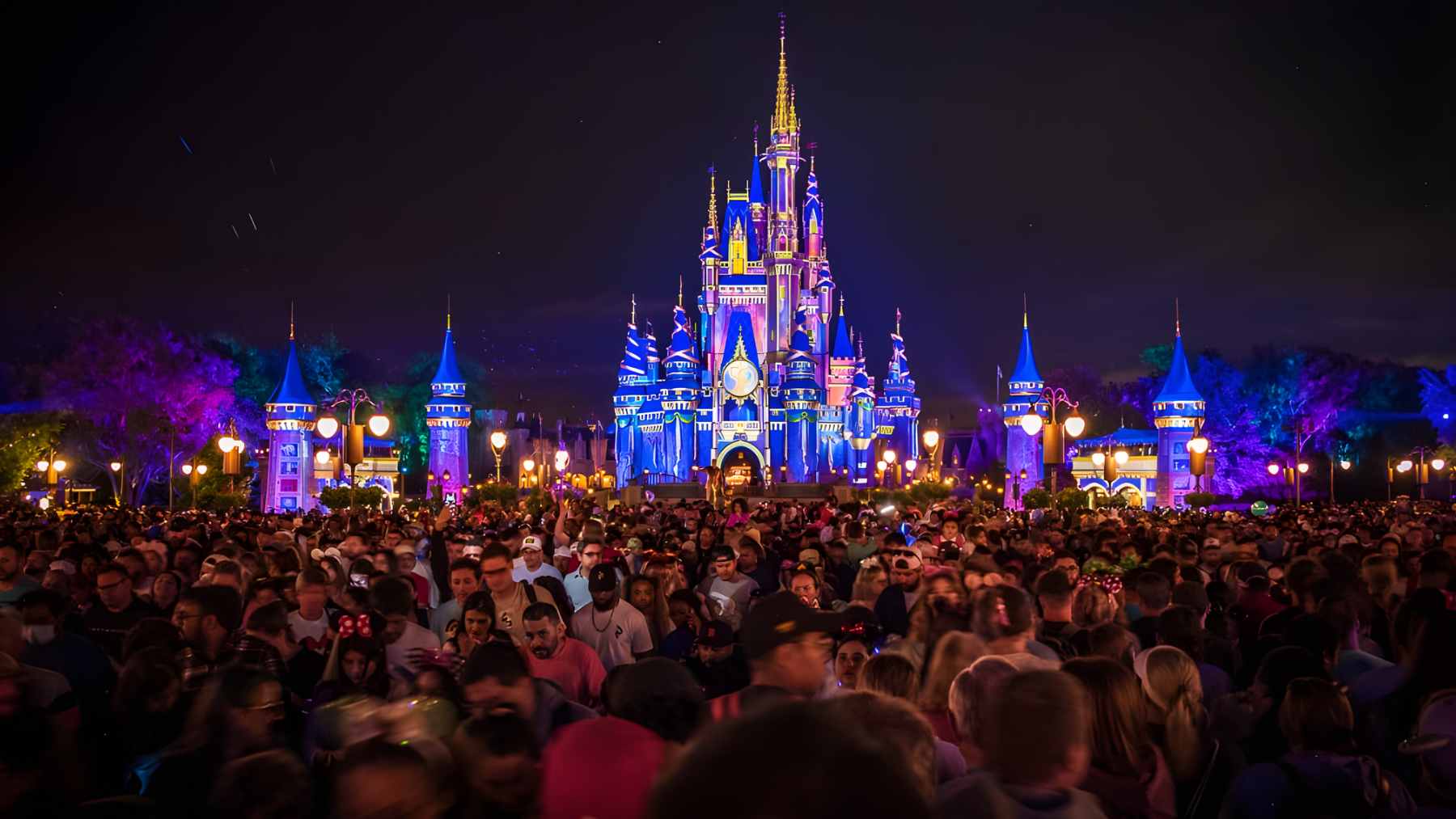
Of course, tech comes with tradeoffs. Real time crowd management depends on data, and data always raises questions about privacy, fairness, and who gets the “best” time slots when demand outstrips space.
Climate resilience is also a security issue
A full park is not only about long lines, it can become a health and safety problem when extreme weather hits. UK public health guidance for mass gatherings recommends treating hot weather as a planning risk, with basics like adequate drinking water, more shade, and scheduling activities at cooler times of day.
The World Health Organization has also warned that warmer temperatures are already increasing health risks at mass gatherings in a hotter world.
This is where the Military and Defense angle quietly enters the chat, even at a theme park. NATO has described climate change as a “threat multiplier” that affects security operations and makes planning harder, which is the same logic big venues are now forced to adopt when they build resilience plans for heat, storms, and disruptions. It is not drama, it is just the new checklist.