If you’ve seen people stash their car keys in aluminum foil lately, it’s not paranoia. It’s a low-tech response to a very modern problem. Keyless entry systems are convenient, but criminals have learned how to exploit the wireless signals that make them work.
Here’s the twist that matters for the environment. A quick foil wrap can help, but it also highlights a bigger reality.
As cars become more connected and more electrified, cybersecurity is starting to look like a sustainability issue, too, because preventing theft can mean preventing unnecessary replacement, manufacturing, and waste.
How the theft work
Keyless entry is designed to make your life easier. When the key is nearby, the car can unlock or start without you pressing a button, which is why these systems are now baked into most new vehicles.
An Analog Devices overview notes that over 70% of vehicles made “today” include remote keyless entry, commonly using 315 MHz in the U.S. and Japan and 433.92 MHz in Europe.
The most common trick criminals use is a relay-style attack. In simple terms, one device listens for your key’s signal and another forwards it to the car, making the vehicle believe your key is right next to it.
Researchers surveying modern vehicle wireless attacks describe passive keyless entry and start systems as vulnerable to relay attacks that can involve two attackers, one near the key and one near the car.
Police guidance puts it bluntly. In keyless “relay theft,” a device fools the car into thinking the key is close enough to unlock and start, even when the key is inside your home. That only works because the system trusts proximity based on radio communication, not on what you can physically see.
A Faraday cage in your pocket
So why aluminum foil? Because it can act like a basic electromagnetic shield when it fully surrounds what you’re trying to protect. Scientists have known this for nearly two centuries, ever since Michael Faraday demonstrated that a conductive enclosure can create a region inside that is protected from external electrical influence.
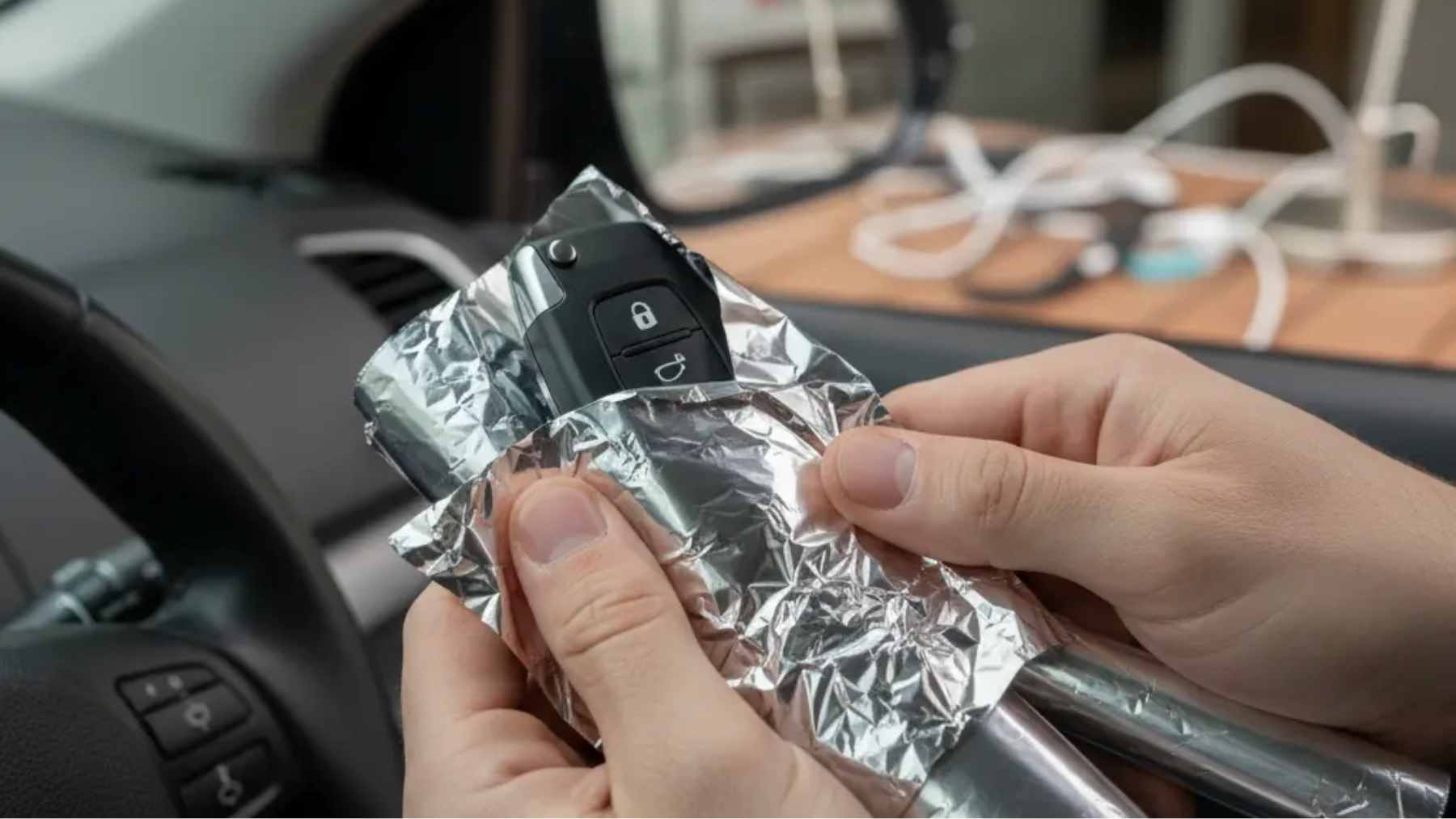
A foil wrap is essentially a tiny “Faraday cage” around your key fob. If it’s sealed well enough, it can reduce the ability of a thief’s equipment to “hear” or relay the key’s signal. That’s the physics behind the trend, even if most people first hear about it through social media and neighborhood chatter.
But there’s an important practical catch. Shielding depends on coverage and gaps, which is why official advice tends to favor purpose-built signal-blocking pouches that you can test. UK police guidance explicitly recommends a screened or signal-blocking pouch (a “Faraday Bag”) and suggests checking periodically that it still blocks the signal.
The waste problem nobody mentions
Aluminum feels “clean” because it’s recyclable. In real life, recycling rates are a lot messier, especially for packaging and foil that gets crumpled, contaminated, or tossed without a second thought.
The U.S. Environmental Protection Agency reports that in 2018 the total recycling rate for aluminum containers and packaging (including foil and other packaging) was 34.9%.
That same EPA data says landfills received about 2.7 million tons of aluminum in 2018. That is not just a climate issue, it’s a material loss problem, the kind that makes “circular economy” talk feel painfully distant from the trash can under the sink.
And it matters because recycled aluminum is far less energy intensive than primary aluminum. The Aluminum Association states that recycled aluminum saves 95% of the energy needed to make new aluminum, and it warns that falling recycling rates mean more than $800 million worth of aluminum ends up in landfills.
The business response
Vehicle theft is not just a personal headache. It’s an industry-wide cost that shows up in insurance claims, fleet downtime, and the price of doing business, from delivery vans to rental cars.
In the U.S., the National Insurance Crime Bureau says vehicle thefts declined in 2025 to 659,880, down 23% from 2024, yet “one vehicle is still stolen every 48 seconds.”
That drop is real, but so is the pressure to keep tightening defenses, especially as criminals industrialize the tools. NICB President and CEO David J. Glawe credited “coordinated prevention efforts” across law enforcement, manufacturers, and insurers, while still emphasizing vigilance.
Automakers have already seen how quickly theft trends can spike around specific weaknesses. NICB notes that thefts involving Hyundai and Kia vehicles have continued to decline for a third straight year, and it ties that downward trend to software updates and theft-prevention measures rolled out in response to real-world exploitation.
The defense lesson
This is where the Military and Defense angle quietly enters the driveway. A relay attack is basically a consumer-grade version of signal exploitation, the same broad idea behind electronic warfare. The tools and targets differ, but the principle is familiar. Control the signal, control the system.
Governments are starting to treat these devices less like “gadgets” and more like organized-crime infrastructure.
In the UK, the Home Office announced new laws to ban possession or distribution of electronic devices used in vehicle theft, saying such devices were used in 40% of vehicle thefts in England and Wales. Minister Dame Diana Johnson said, “These thefts have a devastating effect on victims.”
In the U.S., regulators are pushing a broader cybersecurity mindset for vehicles, not just one fix for one vulnerability. The National Highway Traffic Safety Administration promotes a layered approach that focuses on entry points, wireless and wired, with goals like timely detection, rapid response, and building resilience into vehicle systems.
What drivers can do now
Start with the easy habit changes. Where do you put your keys when you walk in the door? That little bowl by the entryway is convenient, but it’s also predictable. Police guidance recommends keeping keys well away from the car at home and using a signal-blocking pouch, then testing it every few months to make sure it still works.
If you want the foil approach, treat it as a stopgap, not a lifestyle. A reusable Faraday pouch reduces ongoing waste, and it’s closer to what law enforcement actually recommends than burning through roll after roll of foil.
If you do use foil, the environmentally responsible move is to reuse it carefully, then follow local recycling rules, since acceptance varies and contamination can derail recycling.
The longer-term fix is better tech, not better wrapping. Industry standards are already moving toward systems that verify real proximity rather than just receiving a relayed signal.
The Car Connectivity Consortium explains that ultra-wideband time-of-flight measurement can prevent relay attacks based on signal amplification by verifying that the device is truly nearby, a defense it calls “secure ranging.”
The press release was published on National Insurance Crime Bureau.