
Could the human brain be listening to the planet’s background hum without us noticing? That is the question behind a new hypothesis from researchers linked to Politecnico di Torino.
Their work suggests consciousness may not arise from neurons alone and that the brain could, in theory, interact with weak environmental electromagnetic fields, including Earth’s Schumann resonances, the natural waves generated between the planet’s surface and the ionosphere.
Here is the key detail many readers should keep in mind: this is not proof that Earth’s electromagnetic environment is shaping the mind, rather, it is a theoretical framework, not a clinical or behavioral trial, and the paper itself states that “No data was used for the research described in the article.”
What Marco Cavaglià and Jack A. Tuszynski propose is that lipid membranes, vicinal water, and cerebrospinal fluid may form a coherent biological substrate that can couple with internal and external electromagnetic fields.
They also lay out experiments that could test whether the idea survives real-world scrutiny.
Earth’s background signal
Schumann resonances are part of the planet’s hidden electrical weather, even if they are not something you notice the way you notice a thunderstorm rolling in.
NASA describes them as standing electromagnetic waves maintained by lightning worldwide, with a fundamental frequency of 7.83 hertz and higher modes at 14.3, 20.8, 27.3, and 33.8 hertz. Those values sit near low-frequency EEG bands often used to describe brain activity, which helps explain why the idea keeps attracting scientific attention.
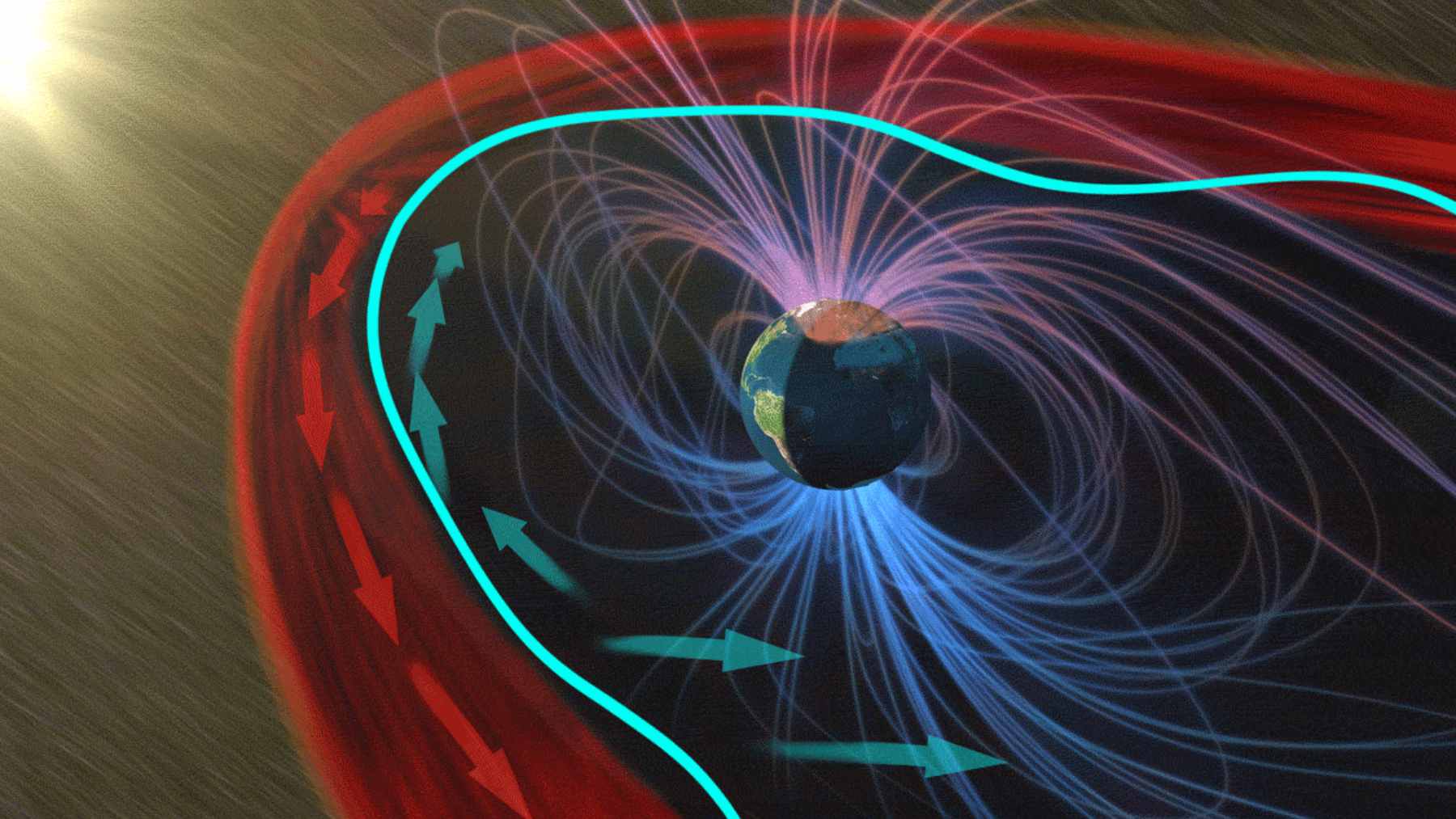
Can the brain, already electrical by nature, “tune in” to a signal that faint? That remains an open question.
A companion BioSystems paper pushes the idea further through an Energy-Mass-Information model, or EMI, which describes cognition as movement among stable “attractor” states shaped by internal and external fields.
Also, hyperscanning research records brain activity from more than one participant at the same time, and a 2024 meta-analysis of 17 fNIRS studies involving 1,149 dyads found robust interpersonal neural synchronization in close relationships.
That does not prove Earth/brain coupling. Still, it helps explain why researchers think synchronization across biological systems is worth studying with better tools and much tighter experiments.
At the end of the day, this story is less about a dramatic discovery and more about a serious attempt to test an unusual idea.
The theory is bold. The evidence is still early–very early. If future experiments support it, the work could open new questions for neuroscience, consciousness research, and even neurotechnology.
Until then, readers should treat it as a hypothesis, not a medical finding and not a reason to make sweeping claims about how the planet controls the mind.
The study was published in BioSystems on ScienceDirect.