Russia is quietly upgrading a key artillery factory in Yekaterinburg with precision machinery from Europe and Taiwan, even though the plant sits inside a heavily sanctioned defense sector.
Internal documents and satellite images analyzed by independent investigators show that Plant No. 9 is adding at least 22 large industrial tools from Germany, Italy, the United Kingdom and Taiwan to churn out more gun barrels for howitzers and tank cannons.
On paper this looks like a story about sanctions, drones and front lines. In practice it is also a story about emissions and the long shadow of a fossil fueled war economy.
So why should anyone who mostly worries about the electric bill or summer heat waves care that a Russian gun factory is humming again? Because every new barrel, shell and tank rolls out of a chain of steel, explosives and diesel that pushes climate targets further out of reach.
A sanctioned factory with European fingerprints
According to a joint investigation by Frontelligence Insight and the analytical group Dallas, Plant No. 9 has been undergoing continuous modernization since at least 2016.
The latest phase centers on an integrated production line for the 152 millimeter 2A88 artillery system used in Koalitsiya self propelled howitzers and guns for T 90 and modernized T 62 and T 72 tanks.
Technical drawings and purchase lists reviewed by the team show an upgrade that depends on big, traceable machines rather than tiny dual use chips.
Among them are German built DMG MORI milling centers, Liebherr gear hobbing and shaping machines, Italian Tacchi turning centers, Parpas horizontal mills, Taiwanese Kafo and Glory machining equipment and a British Jones and Shipman grinding machine.
Investigators conclude that Russia has not managed to replace this kind of high precision industrial equipment with domestic alternatives. Nearly all critical stages at Plant No. 9 still rely on Western or East Asian tools, despite years of official talk about import substitution.
These machines do not only shape metal. They also lock in years of high energy, high carbon production that rarely shows up in climate debates.
More shells, more tanks, more carbon in the air
Frontelligence and its partners estimate that artillery and mortar fire still caused roughly one quarter to one third of battlefield casualties in Ukraine in 2025, even as drones grab headlines.
To feed that fire, Russia has ramped up ammunition output. Internal documents cited by the same investigation indicate that Russian forces received about 1.43 million 120 millimeter mortar rounds in 2024 and nearly 1.96 million in 2025. Deliveries of 152 millimeter artillery shells rose to about 1.72 million in 2025.
A United States Senate report and allied assessments suggest that by 2025 Russia was expected to produce around 250 thousand artillery shells per month, while also pushing toward yearly production of roughly 1,500 tanks, 3,000 armored vehicles and 200 Iskander ballistic and cruise missiles.
Every one of those shells and armored hulls embodies energy intensive steelmaking, explosives production and transport.
Research published in Nature Communications finds that military industries are typically more emission intensive than civilian sectors and that a one percent increase in the global share of military spending in the economy is strongly associated with higher carbon intensity worldwide.
In simple terms, when budgets shift from insulation and solar panels to tanks and ammunition, global emissions tend to rise.
Old tanks, new output and deep rooted corruption
For Pekka Toveri, former head of intelligence at the Finnish Defense Forces and now a member of the European Parliament, the Yekaterinburg story also exposes a system hollowed out by corruption.
Speaking to Finnish broadcaster Yle, he notes that many of the tanks Russia sends to Ukraine are decades old, patched up just enough so the tracks turn and the turret rotates.
Toveri puts it bluntly. In his words, “Thank God, the Russian armed forces are the most corrupt armed forces in the world,” arguing that Russia has invested far more money in its military than Ukraine over two decades yet lost much of it to theft at every level.
High profile projects reflect the same pattern. The T 14 Armata tank, promoted for years as a next generation breakthrough with an unmanned turret, has never entered true mass production and even stalled in a televised parade rehearsal.
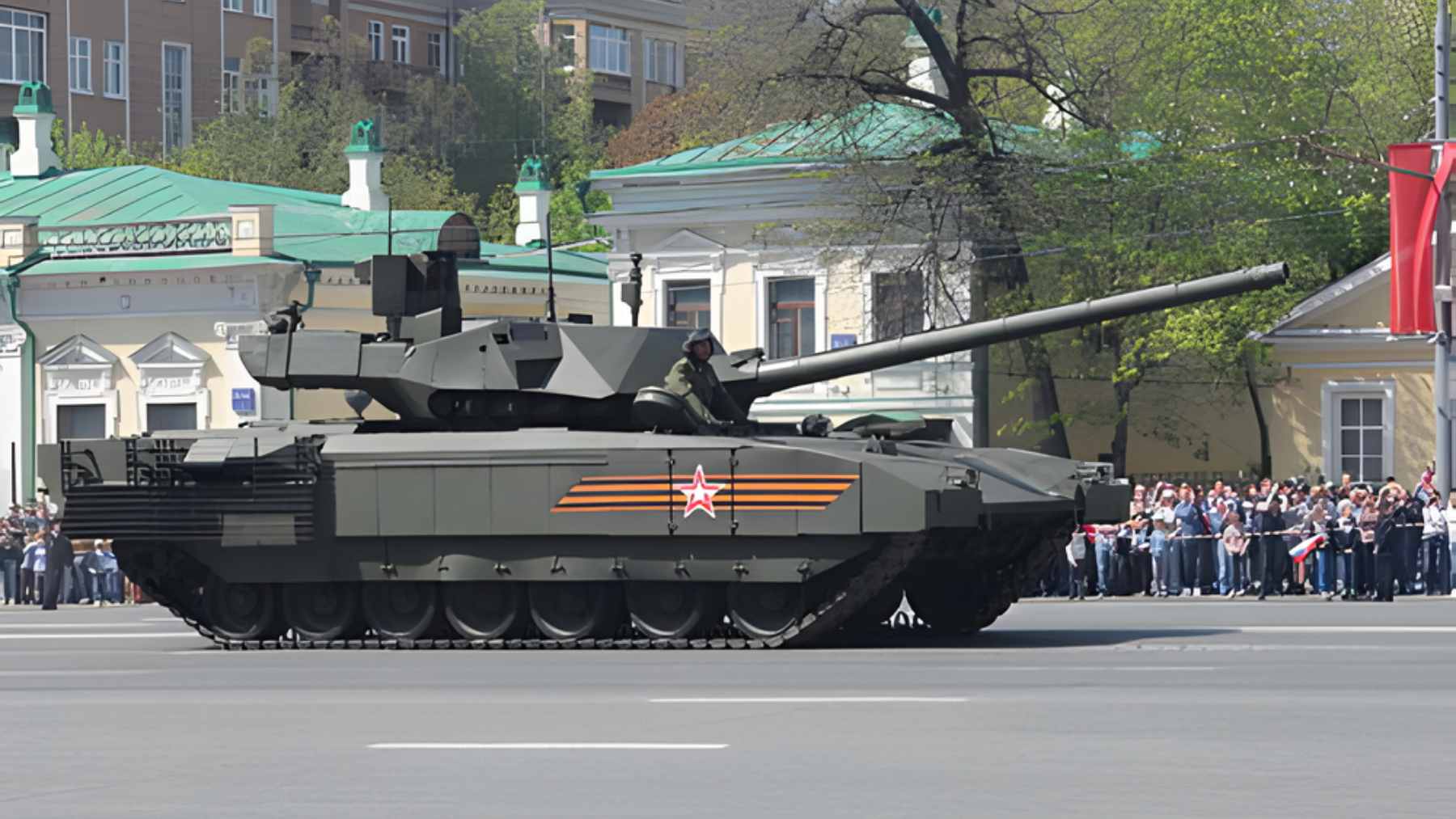
Only a small batch appears to have been built before the program was quietly frozen because of cost and complexity.
From a climate point of view this is a double waste. Resources and emissions go into flashy prototypes while older Soviet era hulls are refurbished in large numbers for a grinding war of attrition.
The hidden climate tab of war factories
Globally, militaries are estimated to account for about five and a half percent of greenhouse gas emissions, yet reporting is patchy and often opaque.
Recent analysis by the Conflict and Environment Observatory shows that the top military spenders, including Russia, either fail to report military emissions in detail or bury them inside broader categories, which keeps the true footprint in the dark.
A separate study in Nature Communications warns that sustained increases in global military spending could delay or even derail efforts to keep warming near one and a half degrees Celsius. In some scenarios, higher military outlays alone are enough to postpone that target by more than a decade.
Ukraine has begun to put numbers on what that means in real life. An assessment for the Ukrainian government estimates that the war has added over 230 million metric tons of carbon dioxide equivalent emissions so far, on top of massive damage to forests, farmland and water.
At the end of the day, upgraded gun factories in the Urals and rising artillery stockpiles are not only a security headache. They are part of the same emissions puzzle as household heat pumps, electric cars and offshore wind, only far less visible to the public.
The investigation that underpins the revelations about Plant No. 9 and its imported machinery was published on Frontelligence Insight.