What happens when a fishing fleet stops looking like a fishing fleet? In the East China Sea, that question is suddenly hanging over Japan, China, and the waters that feed both security planners and seafood markets.
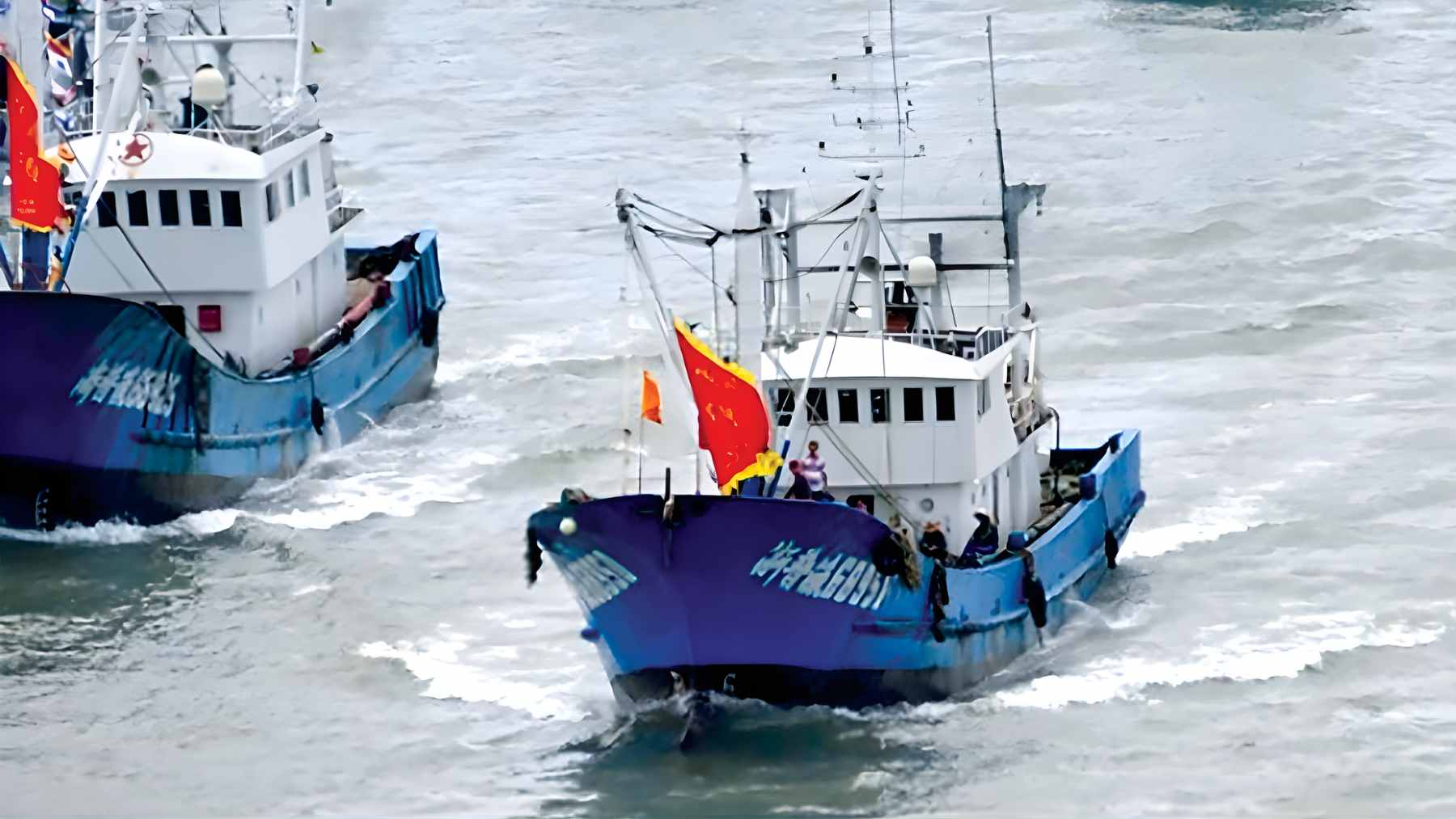
Nikkei Asia reported that as many as 2,000 Chinese fishing boats gathered near Japan’s exclusive economic zone twice in recent months, while ship tracking and satellite imagery showed long, tight formations that stayed in place for more than 24 hours.
Japan’s response quickly moved from screens to enforcement. Reuters reported that Tokyo seized a Chinese fishing boat and arrested its captain on February 13 after the vessel allegedly ignored orders to stop for inspection in Japan’s EEZ off Nagasaki.
Beijing answered by urging Japan to respect the China-Japan Fisheries Agreement and protect the crew’s rights.
Why this matters beyond the map
At one level, this is a familiar sovereignty dispute. Japan’s Foreign Ministry said on March 1 that Chinese coast guard ships continue “unilateral attempts to change the status quo by force or coercion” around the Senkaku Islands, and Reuters reported that Chinese coast guard vessels were seen near the disputed islands on a record 357 days in 2025.
That is not just distant diplomacy. It shapes who feels safe enough to fish there in the first place.
But there is another layer, and it is easy to miss when the story turns into flags and patrol boats. China’s own Foreign Ministry has said the bilateral fisheries agreement matters for the “sustainable utilization and development” of East China Sea fishery resources.
In practical terms, that means these waters are supposed to be managed as a shared living system, not just used as a floating message board.
The sea itself is part of the story
That matters for ordinary people too, especially anyone who has watched seafood prices creep up at the store. FAO said in June 2025 that 64.5 percent of global fishery stocks are fished within biologically sustainable levels, while 35.5 percent are overfished.
So when thousands of vessels appear in coordinated clusters in already sensitive waters, the pressure is not only strategic. It can also cut against the very resource base those fisheries depend on.
The U.S. Defense Department says China’s maritime militia uses fishermen and other marine workers to supplement the navy and coast guard, and that it operates in the East China Sea as well as other nearby waters.
That does not prove the recent flotillas were militia activity. Still, it helps explain why analysts are treating this as more than a normal winter fishing rush. Commercial satellite data can now show those patterns in striking detail. And that changes the story.
At the end of the day, this is not only about a line on a map. It is also about whether one of Asia’s most important fishing grounds is being managed for food, stability, and the long haul.
The official statement was published on the Ministry of Foreign Affairs of Japan.