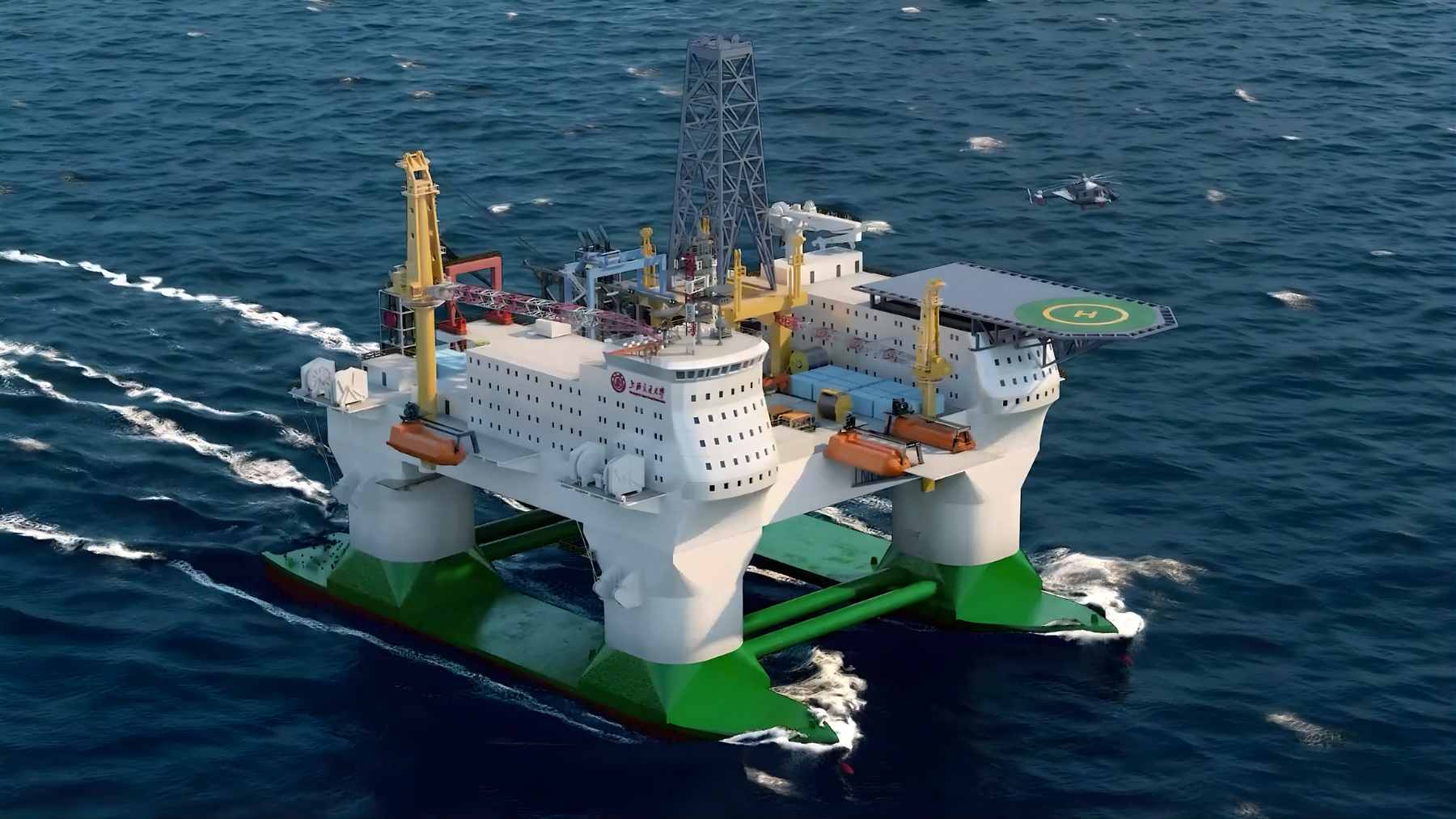
China has begun construction in Shanghai on a massive “deep-sea floating” research platform that state media describes as a national science and technology infrastructure project.
The facility is designed for long-duration operations in deep-sea mission areas, with experimental work reaching ocean depths of up to 10,000 meters and sea trials for heavy equipment. Completion is currently slated for 2030.
But there’s a second storyline that makes this more than a science headline. In earlier technical reporting, engineers tied to the project described nuclear blast protection and a bunker-like structure, which is an unusual feature for something presented as civilian research.
If you care about ocean ecology, the takeaway is simple and a little unsettling. The tools being built for “marine science” can also speed up resource extraction and strategic presence in fragile waters.
What China is building
According to a CGTN report carried on CCTV.com, the facility is being built by Shanghai Jiao Tong University and includes three major systems, the main platform, shipborne laboratories, and shore-based support. The lab work is expected to cover marine disasters, meteorological observation, the underwater physical environment, and related research areas.
In practical terms, it’s closer to an offshore platform than a typical research ship. The platform uses a semi-submersible, twin-hull design for stability and is meant to support sea trials for equipment weighing up to about 110 tons, plus research down to 10,000 meters.
It is also described as rapidly mobilizable, so it can shift operating areas when missions change.
Separate reporting has put even bigger numbers on the table, including a description of a roughly 86,000-ton platform designed to host 238 people for up to four months without resupply. Timelines also vary, with some earlier reports pointing to a 2028 operational target while the more recent state-media timeline points to a 2030 completion.
That gap matters for everything from budgets to oversight, because a project this large tends to take on a life of its own once it’s underway.
Why the bunker matters
If this is “just” a research platform, why design it to survive extreme blasts? Reporting tied to a Chinese engineering paper said the structure uses “metamaterial” sandwich panels, an engineered layer-cake meant to soften shock loads, described as turning “catastrophic shocks into gentle squeezes.”
That language is hard to ignore, and it immediately pushes the story into the military and dual-use space.
The same reporting said the design rationale focuses on protecting critical compartments for emergency power, communications, and navigation control. Researchers argued that blast protection for those spaces is “absolutely vital.”
Even taken at face value, that’s a reminder that ocean infrastructure is increasingly being designed with worst-case scenarios in mind, not just storms and waves.
This sits in a wider pattern that defense analysts already watch closely. Fixed artificial island bases in the South China Sea have been used to support longer deployments and patrol operations, because ports and logistics let ships stay on station longer.
A mobile platform could offer some of the same “stay longer” advantages, while avoiding the political and environmental costs of building new land in place.
The ecology cost of living at sea
The environmental context is not theoretical, especially in reef-heavy seas. A Scientific Reports study quantified how dredging tied to island construction can create enormous sediment plumes and measurable changes in water properties around reefs.
In one case study, the paper reported backscatter increases of up to 350%, sediment plumes exceeding 100 square miles at times, and a cumulative area impacted by dredging exceeding 460 square miles.
The US-China Economic and Security Review Commission has also described the scale of reclamation in blunt terms.
It reported that China built close to 3,000 acres of artificial islands on seven coral reefs it occupies in the Spratlys between December 2013 and October 2015, warning that impacts can extend to fisheries beyond the immediate construction sites. For communities that rely on seafood and coastal livelihoods, those ripple effects are not abstract science, they’re dinner and income.
So, a moveable platform could sound like progress if it reduces the incentive to bury reefs under sand.
On the other hand, it can still bring chronic pressures, including noise, operational discharge, and the simple fact that it helps humans remain in sensitive areas longer. And officials also say the platform will help reveal seasonal patterns in marine ecosystem evolution, which could be a genuine scientific gain if the data is shared and used responsibly.
The business pull of the deep ocean
CCTV.com’s report is unusually direct about commercial applications. It says the completed facility will provide a real-sea testing platform for deep-sea mining systems, key marine equipment, and offshore oil and gas equipment, “accelerating the utilization of marine resources.”
That is a business storyline as much as a science storyline, and it’s one with real environmental stakes.
Deep-sea mining, in particular, is one of the most contested “green transition” supply chain ideas right now, because it targets minerals used in batteries and electronics while potentially damaging ecosystems we barely understand.
A 2025 Nature paper on mining disturbance reported that impacts in the abyssal ocean can persist for at least decadal timeframes, with communities remaining altered in directly disturbed areas despite some recolonization.
Meanwhile, IUCN has called for a moratorium unless and until strict conditions are met, reflecting how much uncertainty still hangs over the practice.
There is also a climate adaptation angle that’s easy to miss. The same CCTV.com report says the platform is expected to improve typhoon forecasting accuracy and enhance disaster prevention and mitigation, which is the kind of benefit that shows up in everyday life when storms threaten power lines, shipping, and insurance costs.
The trouble is that the “science benefits” and the “resource rush” can arrive on the same deck, at the same time.
What to watch next
The biggest unanswered questions are the most practical ones. Where will the platform actually operate, and under what environmental rules for waste, emissions, and spill prevention? What powers a months-long mission, and will there be independent visibility into its environmental footprint?
There’s also the governance question, because the ocean is not just open space where anything goes. Newer international frameworks emphasize environmental impact assessments for large-scale activities that affect marine biodiversity, and those expectations are only getting louder as more industrial activity moves offshore.
In the real world, that means the paperwork and the monitoring need to keep up with the engineering.
For now, the “floating island” reads like a new kind of ocean infrastructure that blends science, industry, and strategic positioning in one platform.
The official statement was published on CCTV.com.