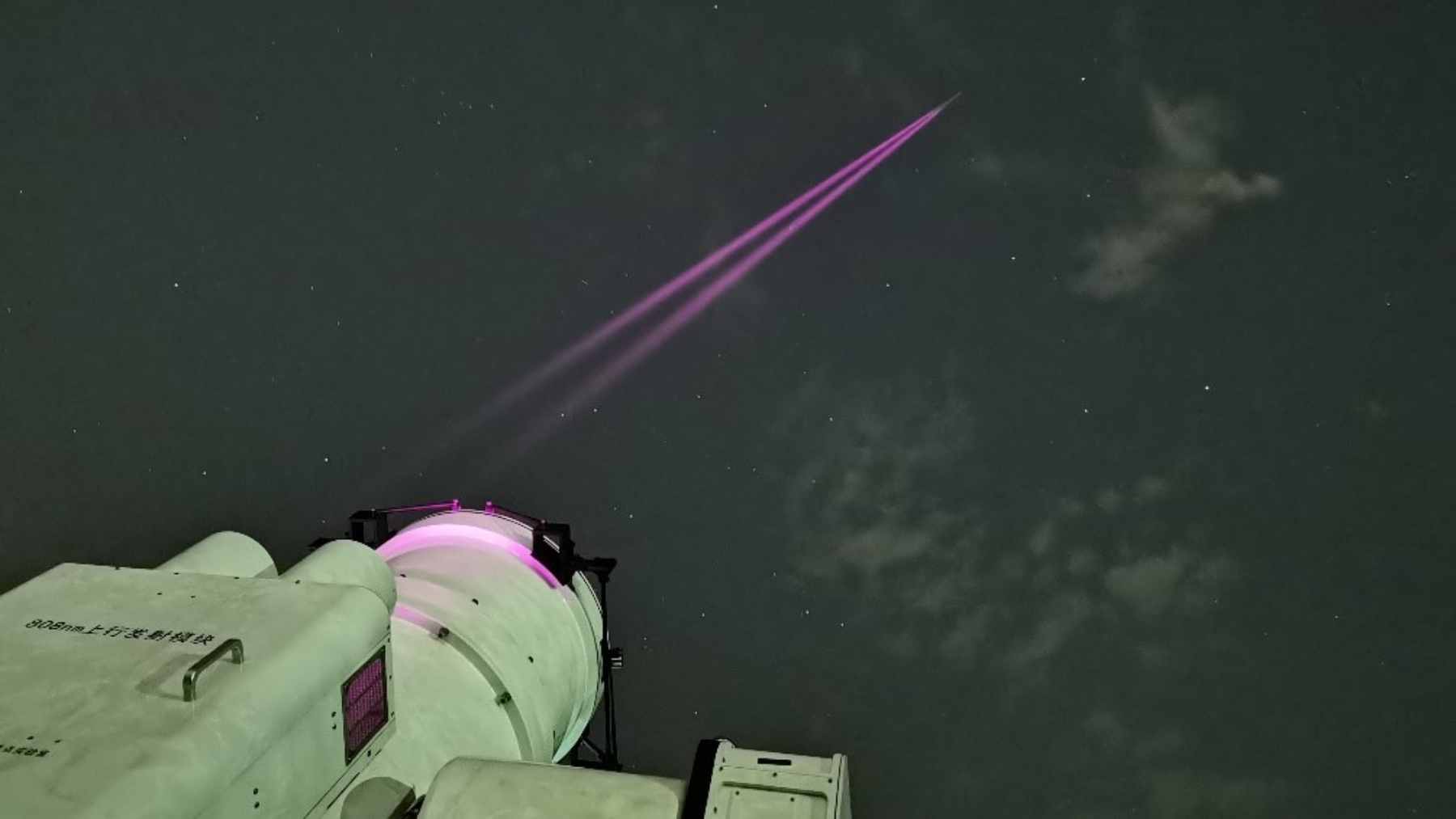
A faint infrared beam dropped from high orbit to a mountaintop telescope in China, then turned into a 1 gigabit-per-second data stream. The experiment is part of a wider push to move more information from space to Earth without cranking up power, and by extension, the electric bill.
The attention-grabbing comparison to Starlink misses the real story. The bottleneck is getting huge files down quickly and reliably, including the satellite imagery used for wildfire maps, flood response, and emissions tracking when every hour matters.
The milestone, plus a newer record
A research team described a 1 Gbps downlink from a satellite in geosynchronous orbit to a specialized ground station at Lijiang in southwest China, using a 2-watt onboard laser and a 1.8-meter telescope on the ground.
In the published technical description, the satellite-to-ground path stretched about 36,702 kilometers (22,800 miles), using a 1550.52 nm optical signal and a 357-actuator adaptive optics system feeding a mode diversity receiver.
In March 2026, the Chinese Academy of Sciences said teams at the same Lijiang Gaomeigu site demonstrated a stable two-way 1 Gbps optical link at a maximum distance of 40,740.96 (25,314 miles) kilometers. The official statement also describes link setup in about four seconds and an uninterrupted connection lasting more than three hours.
Why energy efficiency matters in orbit
Space internet sounds abstract until you remember what sits underneath it, a massive network of power-hungry hardware.
The International Energy Agency estimates global data transmission networks used roughly 260 to 360 terawatt-hours of electricity in 2022, and data centers consumed about 415 terawatt-hours of electricity in 2024, with demand rising fast as AI and cloud workloads grow.
That is why engineers chase lower energy per bit everywhere they can, including space links that funnel data into terrestrial fiber. NASA says optical communications can deliver dramatically higher data rates than traditional radio while using far narrower beams, which can also help limit interception risk.
The tech trick that tames turbulent skies
Laser downlinks have a simple enemy: the last few miles of air. Turbulence near the ground can twist the wavefront and spread the light into a weak, shifting pattern, and clouds can turn a perfect link into silence.
The Acta Optica Sinica paper describes a hybrid approach that assumes the beam will arrive damaged and then “rescues” the usable pieces.
The authors report that combining adaptive optics with mode diversity reception improved received power by 3.94 dB at a 0.9 complementary cumulative probability point and raised the probability of zero bit errors by 19.1% compared with adaptive optics alone.
Earth observation is a data race
So why should anyone outside the space industry care? Because climate monitoring has become a bandwidth problem as much as a sensor problem.
Europe’s EDRS “SpaceDataHighway,” built as a public private partnership between ESA and Airbus, is designed to relay large imaging datasets via laser links for faster delivery to the ground.
If similar optical backbones become more common, satellites could hand off data sooner, letting analysts spot wildfire fronts, track floodwaters, or flag methane plumes while decisions are still on the table.
Business implications, and why Starlink is not the right yardstick
Headlines love the Starlink comparison, but these systems are built for different jobs. Starlink is a low Earth orbit constellation aimed at serving millions of terminals with radio links, and third-party Speedtest data suggests its median U.S. download speeds in 2025 were roughly in the 100 to 130 Mbps range, with uploads closer to about 20 Mbps.
The Chinese demonstrations are point to point, from a fixed high orbit slot to an observatory-class receiver. Because the satellite is so far away, latency is baked in, so this is not automatically “better internet” for real-time apps.
Essentially, it looks more like a high-capacity trunk line for bulk data that can be dropped into fiber, not a dish you place next to your router at home, even if “2 watts” sounds like a night light.
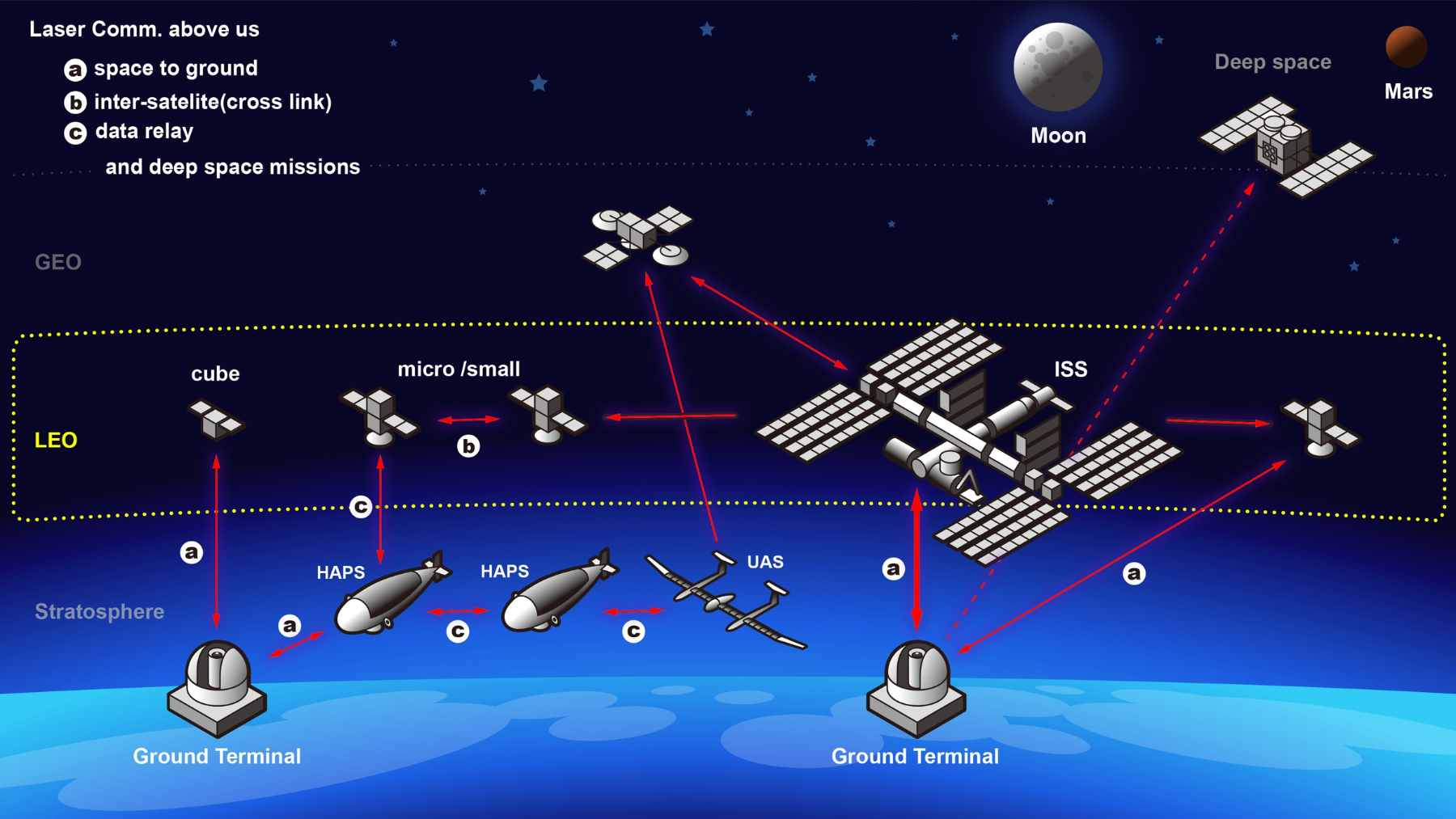
Military and defense is part of the story
There is also an obvious dual-use angle. NASA notes that optical terminals use much narrower beam widths than radio systems, shrinking the geographic area where a link could be intercepted, and defense analysts often highlight jamming resistance as another advantage.
A more capable space backbone can move intelligence, surveillance, and reconnaissance data faster, and it can support resilient command and control.
At the same time, optical links have their own fragility, including weather dependence and the need for precision pointing, so it is not a magic shield.
What to watch next
The big questions now are about uptime and scale. Can these links keep performing outside carefully chosen sites and seasons, and how many ground stations would be needed to keep data flowing through clouds and storms?
If this tech moves from demos to deployments, the environmental math will matter. The launch footprint, ground infrastructure, and power draw of processing chains all add up, even if per-bit efficiency improves, and the “green” win will depend on how operators build and power the rest of the system.
The official statement was published on the Chinese Academy of Sciences website.