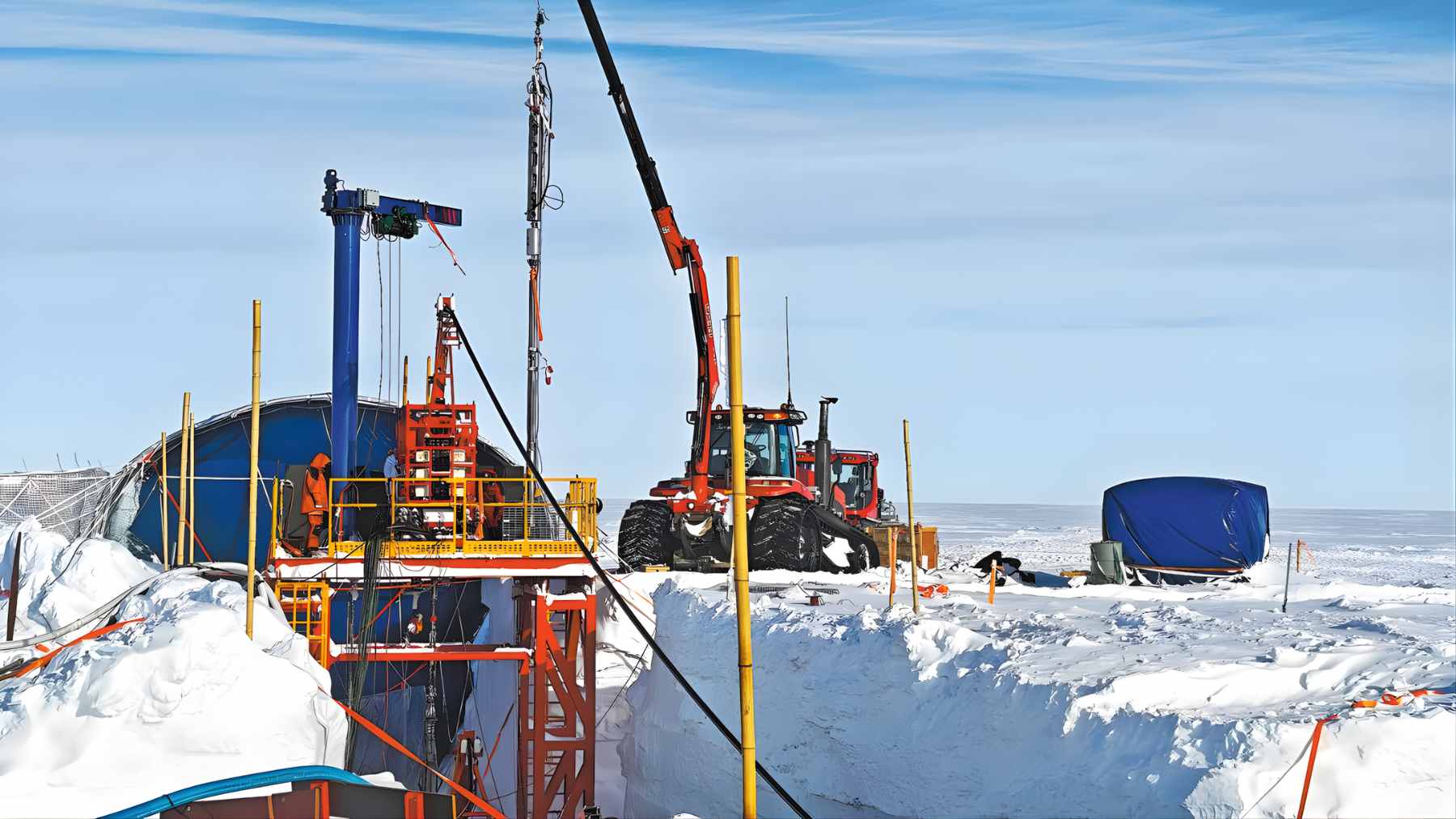
China says its 42nd Antarctic expedition drilled 3,413 meters (2.1 miles) through the ice sheet above the Qilin Subglacial Lake in East Antarctica using a hot-water system, beating the previous polar hot-water drilling record of 2,540 meters.
The Ministry of Natural Resources said the field test was completed on Feb. 5 and is meant to create a “contamination-free” path for later science work.
That sounds like a niche win for polar researchers. But Antarctica’s hidden water systems shape how ice moves, which shapes sea level, which shapes real-life decisions from coastal zoning to insurance math. The big question now is whether the next phase stays as clean as the first hole.
The drill that broke the record
Xinhua reported that the drilling happened in the Qilin subglacial lake area, about 75 miles from China’s Taishan Station in Princess Elizabeth Land. A 28-member “subglacial lake” team from nine institutions carried out the test, with contamination monitoring listed as part of the operation.
The stated point was not just depth for depth’s sake. By opening a stable access channel, researchers want to lower instruments and eventually collect water and lakebed sediments without chemically polluting or biologically seeding an ecosystem that has been sealed off for a very long time.
Why a hidden lake matters for climate
Subglacial lakes sit in brutal conditions, with high pressure, low temperatures, darkness, and very limited nutrients, yet they can still host life and preserve archives of ice-sheet history. China’s own expedition planning described these lakes as critical for understanding climate change and the evolution of life in extreme environments.
Then there is the part that hits closer to home: NASA says the Antarctic ice sheet holds enough ice to raise global mean sea level by about 58 meters if it all melted, and that Antarctica loses around 165 billion tons of ice per year on average.
Nobody expects a 58-meter jump anytime soon, but even inches matter when storm surge is already lapping at roads and basements.
Clean drilling is a tech problem first
Hot-water drilling melts its way down with high-temperature, high-pressure water instead of cutting ice with a mechanical bit. In reporting tied to the ministry’s announcement, the technique is described as faster and generally “cleaner” than some traditional drilling approaches because it uses water as the drilling medium.
Still, “clean access” is not automatic. A China Daily photo caption of the operation highlighted an ultraviolet lamp ring around the borehole entrance to sterilize the drill and hose, aimed at reducing microbial contamination.
Internationally, SCAR has a code of conduct for research in subglacial aquatic environments that treats contamination control as a core requirement, not an afterthought.
The business and defense spillover
A 3,413-meter hot-water drill is also a supply-chain story involving heaters, pumps, filtration, sensors, winches, power systems, and long-distance transport across sea ice and inland routes.
Beijing’s expedition brief also pointed to upgrades at Qinling Station, including a wind-solar-hydrogen-storage hybrid energy system intended to cut fossil fuel use by over 110 tons a year and an AI-driven logistics warehouse aimed at improving material handling efficiency.
Defense watchers have a different reason to pay attention. The Antarctic Treaty says the continent must be used for peaceful purposes only and bans “measures of a military nature,” while still allowing military personnel or equipment for scientific research and other peaceful purposes.
That means national programs can build serious cold-region capability, but the legitimacy of that capability depends on transparency and strict environmental compliance.
The environmental rules are the real stress test
Antarctica is governed, not owned. The Protocol on Environmental Protection to the Antarctic Treaty designates the continent as a “natural reserve, devoted to peace and science,” and it requires environmental impact assessments for activities, with reviews scaled to the likely impact.
Subglacial lake work is exactly where those guardrails matter most. The U.S. National Academies have warned that careless sampling can compromise both the environmental integrity and the scientific value of these environments, which is why internationally agreed stewardship practices exist.
Past projects, including U.S. sampling of Subglacial Lake Whillans using a microbiologically clean hot-water drill, show how much effort goes into keeping surface microbes out of the lake.
So what should readers watch next? Details on contamination monitoring, sample plans, and whether the results are shared widely in line with the Treaty’s expectation that scientific observations and results be exchanged and made freely available.
The official statement was published on Xinhua.