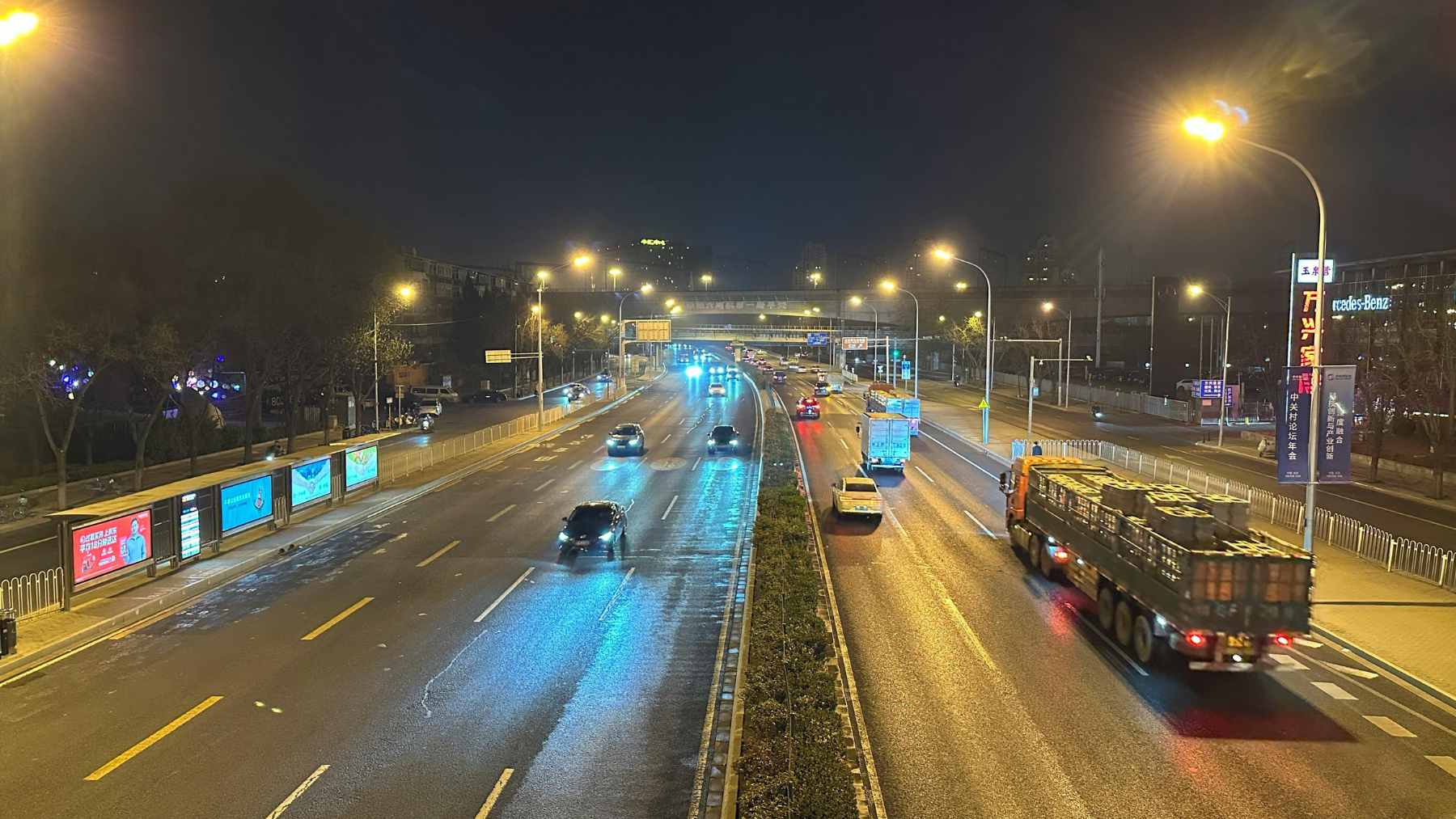
Long night drives have a way of turning the road into a lullaby. China is now testing a surprisingly simple counterpunch on some highways by projecting colored laser and LED light patterns over the pavement at night to keep drivers alert, according to reports from Teleamazonas.
It sounds like a flashy gimmick until you zoom out. Road crashes kill about 1.19 million people every year worldwide, and fatigue is one of those risks that often slips through the cracks in official reporting.
If this “smart road” idea actually reduces nighttime crashes, it could also cut the stop-and-go congestion that wastes fuel and adds pollution, but it may also add more artificial light to ecosystems that already struggle with it.
A light show with a safety job
Teleamazonas describes a pilot system where roadside devices project moving laser or LED light beams across the road in specific stretches, especially where long, monotonous driving can lead to drowsiness.
The goal is straightforward: create a changing visual scene that helps a tired driver stay focused for a few more critical minutes.
The same reporting says the technology is still in a pilot phase, with trials mentioned on routes such as the Qingdao to Yinchuan Expressway and in areas like Zhengzhou, and that authorities have not published definitive nationwide results yet.
That “not proven at scale” detail matters, because a tool that works on one stretch of road can still backfire if it distracts drivers elsewhere.
Drowsy driving is bigger than most people think
Have you ever felt your eyelids get heavy and told yourself you are fine if you just turn up the music?
The U.S. National Highway Traffic Safety Administration says precise counts are hard, but it estimates that in 2017 there were 91,000 police-reported crashes involving drowsy drivers, with about 50,000 injuries and nearly 800 deaths, and it reports 633 deaths from drowsy driving-related crashes in 2023.
The Governors Highway Safety Association goes further on the undercount problem, pointing out that police reports often miss pre-crash drowsiness and that raw fatal crash tallies likely underestimate the true burden. The National Safety Council also highlights survey data that about 1 in 25 adult drivers report having fallen asleep while driving, citing the U.S. CDC.
Less crashing can also mean less pollution
When a crash blocks lanes, the environmental damage is not just twisted metal–it is idling engines, crawling detours, and the exhaust you can literally smell while stuck behind a line of trucks, the kind of delay that makes commutes longer and gas bills higher.
Researchers have long noted that as congestion increases, fuel consumption and carbon dioxide emissions tend to rise, too.
There is also a simple climate math problem hiding in plain sight: running an engine while you are not moving still burns fuel. A study in Energy Policy estimated that idling in personal motor vehicles in the U.S. accounts for over 102 million tons of CO2 and 10.6 billion gallons of gasoline per year, about 1.6% of total U.S. emissions, based on survey-driven estimates.
Any safety measure that reduces crash driven backups has a real chance to shave off some of that pointless burn, even if the exact savings are hard to quantify up front.
Light at night can disrupt ecosystems
There is a tradeoff people rarely consider in the viral highway videos. Artificial light at night can disrupt wildlife behaviors tied to feeding, reproduction, and migration, and conservation groups warn that nighttime lighting can have harmful and sometimes deadly effects across many species groups.
Peer-reviewed research backs up the broader concern, including a 2025 Scientific Reports study that found artificial light at night reduced nest site occupancy for two owl species in illuminated locations compared with unlit ones.
Lasers used on highways are not the same as urban skyglow, but they are still light introduced into the nighttime environment, and that is why timing, directionality, and intensity should be treated as environmental design choices, not just engineering details.
Business and defense are watching this tech closely
For businesses that build and run infrastructure, “smart roads” are quickly becoming a product category.
A March 2026 post republished by 10jqka from the official China Merchants Expressway account describes a pilot “active anti-fatigue laser light system” on the Miansui Expressway and claims pilot data showed notable declines in nighttime accident rates, fatigue alarms, and speeding in the tested segment, alongside other sensor-driven safety lighting for fog and tunnels.
Defense planners and emergency managers have a different reason to care: roads are critical logistics corridors when disasters hit or when large-scale mobilization is needed, and nighttime pileups can choke movement for hours.
At the same time, any connected roadside system that can be remotely monitored or controlled raises cybersecurity and safety governance questions, so procurement standards matter as much as the hardware itself.
What to watch before “laser highways” scale up
The next step should be boring, transparent performance data that independent experts can sanity check. Teleamazonas notes that officials have not published conclusive national figures and that the pilot phase includes evaluating real safety impact and the risk of driver distraction, which is exactly what you would want to hear before expansion.
A truly “green” version of this idea would also measure ecological side effects, then design around them with targeted activation windows, careful aiming, and minimal spill beyond the roadway.
Earlier Chinese highway experiments with laser warning zones even described adjusting beam angles to avoid shining into vehicles, and pairing visual cues with other measures, which hints at how safety and restraint can coexist.