
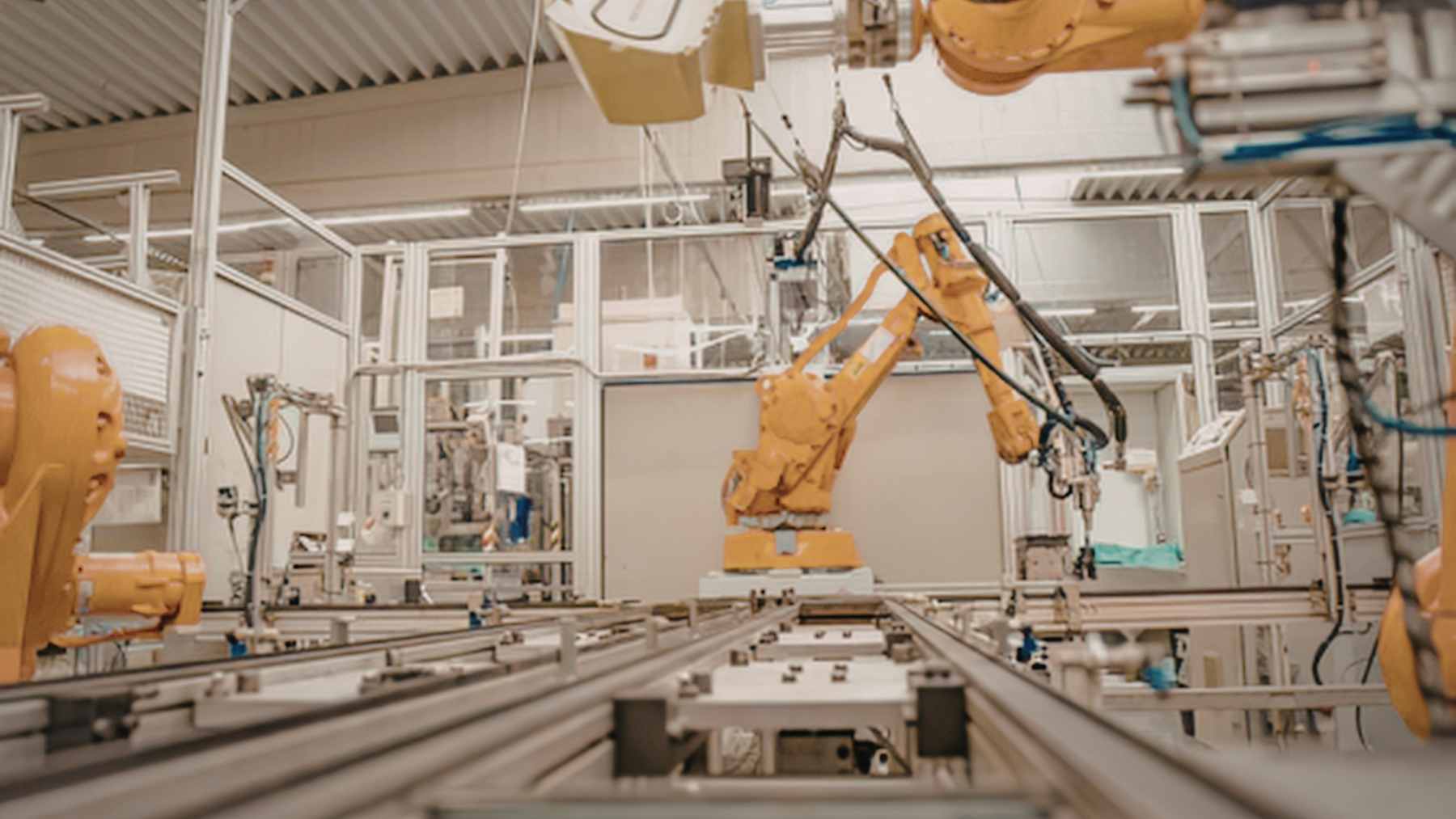
Jeff Bezos is reportedly exploring a $100 billion fund designed to buy manufacturing companies and modernize them with automation and artificial intelligence.
The Wall Street Journal first reported the talks, and Reuters said the plan would target areas like chipmaking, defense, and aerospace. That is the real economy stuff, the factories behind everything from phones to aircraft.
This plan raises environmental concerns: the factory floor is where emissions, energy use, and material waste get baked in for years. If production gets faster but not cleaner, the climate bill can rise right alongside output.
A $100 billion bet on the factory floor
Reuters reported that Bezos is in early discussions with major asset managers about raising the funds and has met with sovereign wealth representatives in the Middle East.
The Journal described it in investor documents as a “manufacturing transformation vehicle,” signaling a large-scale attempt to speed up automation inside traditional industries. Bezos has not publicly commented on the project, Reuters added, and key players have not confirmed details.
The Journal also tied the idea to Project Prometheus, a separate AI startup where Bezos was expected to serve as co-CEO, aimed at engineering and manufacturing applications.
Reuters reported that Project Prometheus has been in talks to raise up to $6 billion and had raised $6.2 billion late last year, with Blue Origin CEO David Limp joining its board. If those tools end up inside acquired companies, factory decisions could start looking more like software updates.
The climate math behind factory automation
Manufacturing is not a side issue in the climate debate. The International Energy Agency says industry emitted 9.0 gigatons of CO2 in 2022, about a quarter of global energy system CO2 emissions. That is why efficiency upgrades can matter, even when they sound boring.
AI can help, at least in theory, by tightening quality control, reducing scrap, and tuning industrial processes to use less heat and power.
But there is a catch: higher output can still mean higher emissions if the energy supply stays fossil-heavy. So the green impact depends on what changes faster, the algorithms or the electricity mix.
Chips and defense are where the emissions hide
Semiconductors are an obvious target for any AI-driven makeover, and they are also resource-hungry. Interface’s Semiconductor Emission Explorer found that energy consumption among a sample of 28 chip manufacturers more than doubled from 58,326 gigawatt-hours in 2015 to 131,278 gigawatt-hours in 2023.
The same analysis tracks shifts in reported emissions across years, which is part of the point, but measuring the footprint is still messy.
Defense and aerospace add another layer because their products are complex, regulated, and built through long supplier networks.
A faster production line for critical components can be a national security story, but it is also an environmental one when it pushes more metal, chemicals, and energy through the system. The sectors named in the report sit where strategic urgency meets climate pressure, and the tradeoffs are not going away.
AI needs power too
There is another environmental angle that is easy to miss. The AI that runs these systems depends on data centers that need large, steady supplies of electricity.
The IEA projects that global data center electricity use could double to around 945 terawatt-hours by 2030, growing far faster than overall electricity demand, with AI-related servers driving much of the increase.
In the United States, the power draw is already noticeable. A U.S. Department of Energy fact sheet says data centers used about 176 terawatt-hours in 2023, roughly 4.4% of total U.S. electricity use, and projects strong growth through 2028.
When that demand collides with sticky summer heat or a deep freeze, it can hit reliability, and yes, sometimes your electric bill.
What to watch next
For now, this is a reported plan, not a fully public launch. That is why the key questions are simple ones, like whether acquired factories would be pushed to measure and cut their Scope 1, 2, and 3 emissions, and how clean power fits into the strategy. If the fund moves forward, transparency will matter almost as much as the technology.
Big Tech is already adapting to grid constraints. Reuters reported that Google signed demand response agreements with five U.S. utilities, allowing it to curtail up to 1 gigawatt of data center demand during peak periods, which Reuters noted is enough to power about 750,000 homes.
Moves like that do not solve the climate puzzle, but they show how quickly AI is turning electricity into a strategic resource.
The IEA’s Electricity 2026 outlook flags that rising power demand is being pushed by electrification across the economy and also by AI and data centers.
In practical terms, any “smarter factory” plan will be judged not just by robots and software, but by the grid it plugs into.
The study was published on International Energy Agency.