If you’ve ever watched your electric bill creep up during intense summer heat, you already know energy is not an abstract problem. Now imagine the same pressure on a global scale, with data centers pulling more power to train and run AI.
Researchers at Northwestern University say they have printed artificial neurons that generate brain-like electrical signals realistic enough to activate living brain cells.
Published April 15, 2026 in Nature Nanotechnology, the work points toward brain/machine interfaces and a new route to ultra-efficient computing. Could this be one of those rare lab breakthroughs that also moves the climate needle?
From ink to spikes
The headline result is the one that matters most. The printed devices produced voltage spikes with timing and shapes close enough to trigger activity in slices of mouse brain tissue, including the cerebellum.
Northwestern’s team says their devices can reproduce multiple firing behaviors, including continuous firing and bursting, which is closer to how real neurons communicate than a single simple pulse. That jump from “one spike” to richer patterns is the whole point.
A trick that turns an “imperfection” into a feature
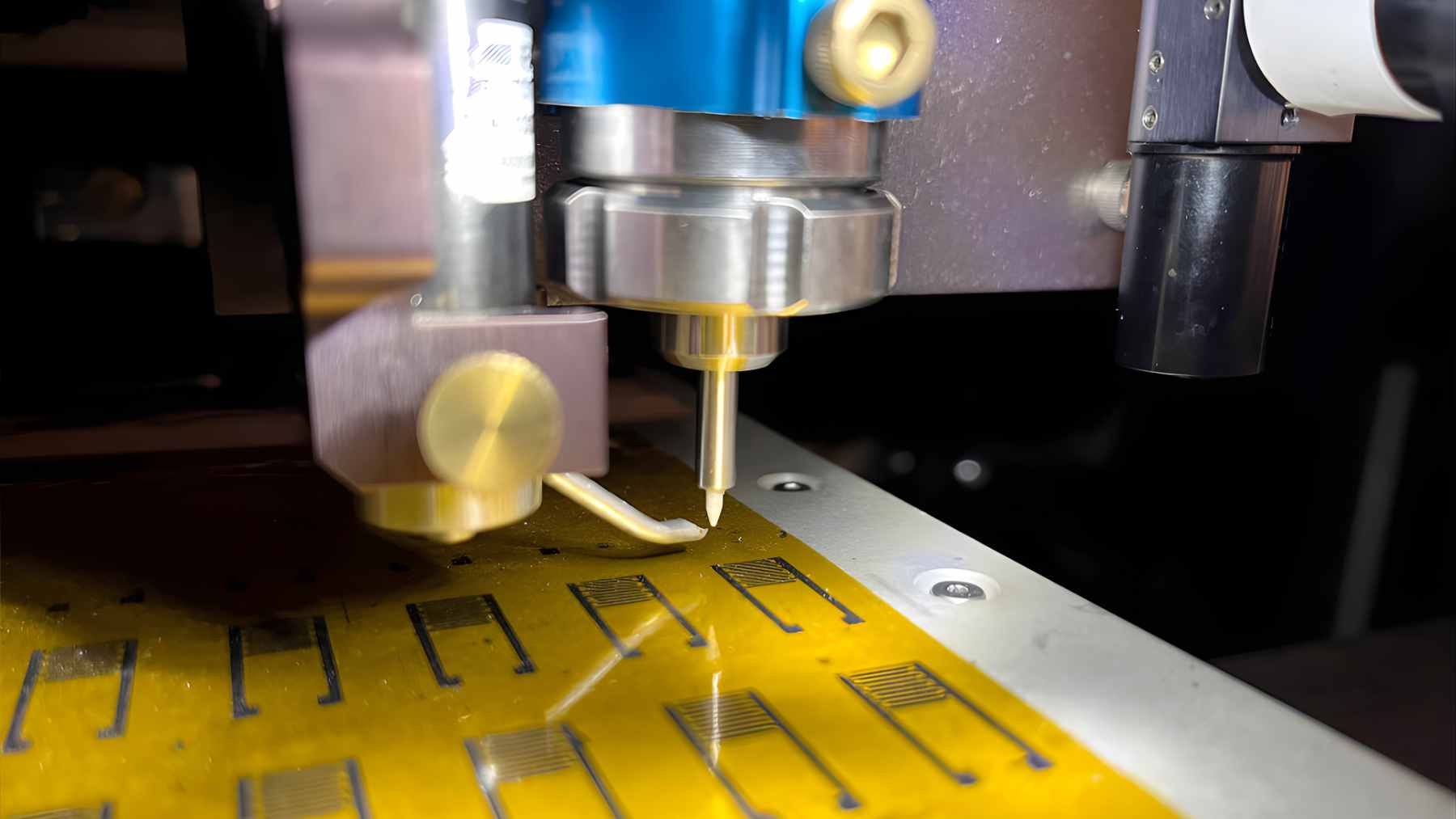
The researchers built electronic inks using nanoscale flakes of molybdenum disulfide (MoS2) as a semiconductor and graphene as an electrical conductor. They deposited the inks onto flexible polymer substrates using aerosol jet printing, which is basically a precision spray printer for electronics.
The clever part is what they did with the stabilizing polymer that helps the ink behave during printing. Instead of fully removing it, the team partially decomposed it so that current flow forms a narrow conductive filament and creates abrupt switching that can mimic a biological spike.
In the Nature Nanotechnology paper, the group reports spike frequencies tunable up to 20 kHz, stable operation for more than one million cycles, and stimulation of Purkinje neurons in mouse cerebellar slices. Those are early, lab-scale results, but they show the devices can run fast and repeatedly enough to matter.
The climate story hiding inside brain-inspired hardware
Energy is what turns a niche chip idea into a climate issue. The International Energy Agency estimates data centers used about 415 terawatt hours of electricity in 2024, roughly 1.5% of global consumption, and says global data center electricity demand grew 17% in 2025.
The IEA also reports AI-focused data centers grew even faster in 2025, and projects overall data center electricity use roughly doubling to around 950 TWh by 2030. That’s why efficiency is suddenly not just a tech talking point, it is a grid planning problem.
Business pressure is coming from both hospitals and hyperscalers
On the medical side, the Northwestern team points to brain/machine interfaces and neuroprosthetics, including implants aimed at restoring hearing, vision, or movement. If devices can deliver signals that feel more natural to neural tissue, future implants could become more precise and potentially less power-hungry.
On the business side, efficiency is starting to look like insurance. The IEA describes a “scramble” for electricity, grid connections, chips, and capital as data center growth accelerates, and it warns the speed of AI adoption is colliding with slower moving infrastructure.
There’s also an uncomfortable twist called “the rebound effect,” where efficiency gains can be outweighed by more usage. So hardware wins only matter if companies also get serious about smarter deployment and clearer energy disclosures.
Defense and the edge, where every watt counts
Defense agencies have been interested in brain-inspired computing for years, mostly for a practical reason. DARPA’s SyNAPSE program described a goal of low-power neuromorphic computers that can process large volumes of data without burning through limited power budgets.
In a 2014 DARPA update on SyNAPSE, the agency highlighted a brain-inspired IBM chip that consumed less than 100 milliwatts during operation and delivered large energy savings on pattern recognition tasks, with potential uses in mobile robots and remote sensors.
It’s the same logic behind today’s edge AI, from drones to field sensors to radios that cannot keep swapping batteries.
Northwestern’s printed approach is still early-stage research, and it is not a drop-in replacement for existing chips. But if printed, flexible, neuron-like devices can be manufactured at scale, they could help cut power and heat in the places where cooling is hardest and downtime is not an option.
The study was published on Nature Nanotechnology.