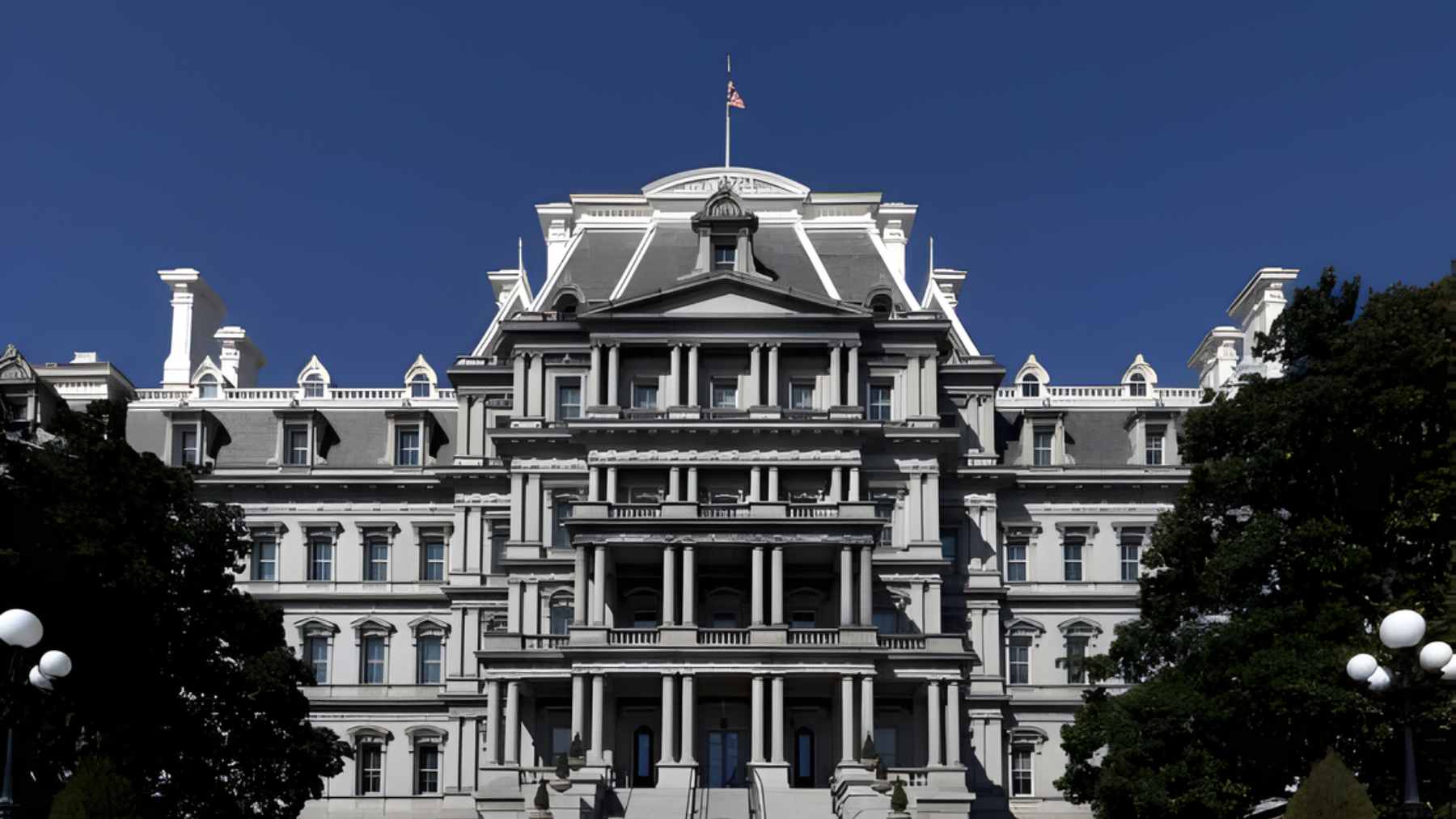
President Trump has submitted a proposal to paint the Eisenhower Executive Office Building white, with a review slated for April 16 by the U.S. Commission of Fine Arts. The slate gray, French Second-Empire-style building sits next to the West Wing and houses key White House offices, including the National Security Council.
On paper, this looks like a straightforward makeover. In reality, painting a historic granite facade is also an environmental and risk-management decision, because it can lock the federal government into decades of maintenance, chemical use, and potential stone damage if the wrong coating is chosen.
A makeover next door to the West Wing
The Eisenhower Executive Office Building was constructed in stages between 1871 and 1888 and was originally built for the State, War, and Navy departments. It is now a National Historic Landmark with highly articulated gray granite facades and a long paper trail of preservation decisions that come with that status.
The submitted materials argue the exterior has been “largely neglected” and say cleaning the stone can be unpredictable in cost and results, with uncertainty around how much water and cleaning solution would be needed.
The proposal presents painting as “repeatable,” and shows options that would paint the upper portions white while leaving some lower granite exposed, or paint larger sections of the façade white.
Painting stone is a material decision, not just a design one
Here’s the part that tends to get lost in the color debate: the National Park Service has long warned that inappropriate cleaning and coating treatments can be a major cause of damage to historic masonry, even when they are chosen with “improvement” in mind.
Coatings can change how a wall handles moisture, and moisture is where cracks, spalling, and costly repairs often begin. NPS guidance also notes that some waterproof coatings can trap water in masonry and worsen damage when that moisture cannot escape, especially in freeze-thaw conditions.
The “magic paint” debate is really about risk
Industry coverage of the plan has zeroed in on the chemistry. Facilities management outlet Facilities Dive reports that a group of restoration specialists disputes claims about mineral silicate-based paint performing as promised on granite, arguing it does not bond to granite the way it does to other mineral substrates and may require primers or abrasive prep that permanently alters the surface.
That dispute matters for the environment because “wrong first, fix later” is one of the dirtiest paths in building maintenance.
Facilities Dive also reports that preservation groups have sued, arguing the project violates laws that require earlier consideration of environmental and historic impacts, including the National Environmental Policy Act and the National Historic Preservation Act.
Repeatable maintenance has a carbon footprint
It is easy to shrug at a paint job until you zoom out. The International Energy Agency says building operations account for 30% of global final energy consumption and 26% of global energy-related emissions, with additional emissions tied to construction materials like cement and steel.
Paint also lives in the real world of air quality rules and supply chains, not just renderings. U.S. EPA regulations set VOC content limits for architectural coatings by category, including limits listed in federal rules for common exterior coating types, which is one reason “low-VOC” products have become a standard talking point in modern projects.
Cool walls and resilient offices
There is a climate angle that cuts in the opposite direction, too. Research summarized by Lawrence Berkeley National Laboratory’s Heat Island Group explains that raising wall reflectance can lower sun-heated surface temperatures, which can reduce daytime heat flow into occupied spaces during the cooling season.
But even that comes with a catch, because the same LBNL summary notes higher wall reflectance can increase heating energy use in winter.
In Washington, D.C., that means the impact is likely to be mixed, and the bigger energy wins still tend to come from things most people never see, such as sealing joints, fixing water intrusion paths, and improving HVAC controls (the stuff that shows up later in the electric bill in summer).
What to watch at the April 16 review
The Commission of Fine Arts meeting agenda lists “exterior improvements” to the Eisenhower Executive Office Building as a concept submission, and it sets the stage for a very public decision about what kind of intervention is appropriate on a landmark granite façade.
Even if the commission is an aesthetics-focused body, the downstream consequences will be practical, including cost, durability, and whether the façade ends up needing more intensive work later.
If you are trying to read the tea leaves, watch for talk of test panels, reversibility, and how the coating would handle moisture over time, not just how it looks on day one. Preservation guidance repeatedly comes back to the same idea–that treatments can be destructive when they are not carefully selected and evaluated for the specific masonry in question.
The official proposal materials were published on U.S. Commission of Fine Arts.